
In-depth interview
01
JLPdecryptage
In 2026, you wrote that you had reopened the “race to a billion” because agentic systems reduce part of the human cost of growth. At almost the same time, you turned down €3.7 million for ScalarX, saying the company was not for sale. At heart, do these two decisions stem from the same conviction: preferring the ability to build over the value of an immediate cheque?
Christophe Casalegno
No, there is no direct link between the two. With or without the race to a billion, I would not have sold ScalarX, and the decision to keep this company exists independently of that ambition. On the other hand, you are right about the importance I place on the ability to build. That really is what matters most to me.
The offer was €3.7 million for ScalarX Europe, plus the cash on hand. So we were at around €4 million before tax. It was a very good offer, and my refusal was not intended to drive up the bidding.
ScalarX provides me with recurring revenue, finances its own development and gives me the means to move forward on other projects, while consuming very little of my time. Selling would have meant giving all of that up in exchange for capital... and then looking for something to do with it.
In the end, I would have had to invest part of that money and launch a new business from scratch, probably with non-compete clauses for a few years, in order to rebuild something that gave me exactly the same advantages I already have :/ The upside was very limited in my situation.
There is also something I find strange in part of the entrepreneurial discourse: you are almost systematically asked how you plan to exit the company you are building. As if the goal necessarily had to be getting rid of it at the best possible price.
Yet a company can also be an extraordinary tool for giving concrete existence to everything you want to accomplish. Why should selling it be considered the natural culmination of the adventure?
I want to clear up one ambiguity: I have no problem with money, or with making a lot of it, but above all I care about what it allows me to do.
In this situation, the cheque would have replaced something whose value to my life and projects I already knew: it was a very good price, but a bad deal.
The reflection about the billion responds to a different question: has the human cost of that trajectory changed enough for me to want to consider it again?
I had set that ambition aside because I had come to understand better what it would require from me. In 2008 I became a father, and I had no desire to pour the years ahead into growing a project, recruiting, coordinating and absorbing human problems... at the cost of becoming a Sunday visitor in my own home.
My experiments with agentic systems led me to re-examine that cost. I am still examining it! Some of the work I previously had to organize around large numbers of people is becoming accessible in other ways. The market, customers and competition are still there, but the relationship between what I can undertake and what I personally have to devote to it is changing enough for me to look at the question again. Reopening it does not mean that I have already made a decision, but I am thinking about it seriously.
I would add that the value of these new capabilities goes far beyond that financial objective. I have projects that I want to give time to and a real chance of succeeding. If I can explore an idea without tying up all my resources for months or years, it also means that I can afford to discover that it was a bad idea. Then try another one. That freedom to explore has enormous value in my eyes!
So I could still perfectly well give up the race to a billion and continue developing ScalarX, using it and refusing to sell it.
The ability to build remains essential in the way I think about this company. How far I want to push my financial ambition is a separate question that I have not yet settled, but I think that will happen soon.
02
JLPdecryptage
You spent eighteen years as an independent consultant, in direct contact with compromised systems, crises and security trade-offs, before structuring ScalarX. What did you learn about IT risk that is difficult to understand from a boardroom until you have encountered it in the field?
Christophe Casalegno
You learn fairly quickly that IT risk does not care at all about the way you present it. You can have perfectly maintained documentation and an organization that is incapable of bringing its operations back online. The day something breaks, that second reality is what matters: everything else — the boxes ticked, the frameworks — disappears.
I should clarify one point about my career: those eighteen years of consulting were not a period during which I was waiting to become an entrepreneur. I was already running Digital Network in parallel from 1999, and I launched multiple activities in different fields ranging from business intelligence to crisis communications, network and datacenter engineering, hardware, telecom operators and online publishing.
So I have experienced these issues both from the field and from the position of the person who has to decide, finance and take responsibility for the consequences. And it is precisely that combination that taught me a great deal.
A crisis reveals, among other things, everything an organization thought it knew about itself. Take a very simple example: “we have backups”. Fine. But do we know exactly what they contain? Can they be restored without relying on the system that has just gone down? Are the necessary access credentials available? And how long does it take to get a genuinely usable service back? Those are different questions. If you collapse them into one green box, you make everything that really matters disappear.
The same applies to dependencies. Two pieces of equipment can create the impression of redundancy while depending on the same point of failure. Two redundant electrical feeds following two different utility paths can terminate on the same STS in a datacenter, and if that fails, the servers will still go down.
Inside the server itself, you can have dual power supplies, but if they are not connected directly to the motherboard, once again a €40 box can fail and take down a server worth €40,000.
A provider can be responsible for a service without having the access required to restore it. A procedure may assume that a specific person will be reachable... when they may not be. On paper, each individual piece can look reasonable. It is the way they fit together that can be fragile.
Field work also forces you to make decisions with incomplete information. Sometimes you have to stop a service to prevent the damage from spreading even though you do not yet know the full extent of the incident. You have to arbitrate between immediate continuity and the risk of putting something compromised back into circulation. Waiting until you know everything can cost far more than making an imperfect but reversible decision.
From a boardroom, you can get the impression that the main problem will be technical. Maybe it will... or maybe it will not! But if nobody knows who is allowed to decide to shut something down, who understands the dependencies, or who must inform customers, the best technical team in the world will lose precious time. A responsibility written in a document is not enough if it is neither understood nor exercised in reality.
What interests me, therefore, is the organization’s actual ability to get through the incident: can the right people act? Do we know how to retrieve the information? Do we understand the infrastructure well enough not to make the problem worse while trying to solve it? A simple architecture that is understood and properly operated can have enormous value in that context.
I am not asking an executive to become a Linux kernel specialist. That is not the point. But they must never confuse having paid for security with having obtained a real ability to protect, react and mitigate.
They should be able to ask for a demonstration, understand its limits and accept that the conclusions may sometimes be unpleasant. That is much less comfortable than a reassuring indicator, but it is also much more useful before customers discover for themselves where the weakness was.
03
JLPdecryptage
You describe Elora as an “operational memory” capable of integrating contradiction, while also stating that the human operator retains authority. When Elora reaches a conclusion that conflicts with your intuition, what ultimately determines your decision? And have you ever followed its analysis against your own initial judgment?
Christophe Casalegno
Generally speaking, I can reconsider an intuition, even a very strong one, if the data shows that I am wrong, and that is true with Elora just as it is with any other system. What interests me is being able to examine the evidence and understand what it demonstrates. The origin of the analysis gives it neither automatic authority nor a reason to be dismissed.
I do, however, want to clarify something about Elora: the project is still under construction. Elora works and is progressing, but she is not finished and is not yet fully effective.
Her memory is deliberately only lightly populated for now because that makes testing and resets easier. That reality has to be kept in mind when discussing what she can already bring me and what I want to build with her.
At a deeper level, my intuition has value because historically it has often proved right, and I have often paid the price for not following it. That said, I also think my intuition comes from my experience and from my ability to detect and connect weak signals that are often ignored.
It can help me notice something before I am able to spell out all the reasons behind it. But the strength of an intuition proves nothing on its own. You can be absolutely convinced and still be wrong. So I confront my intuitions with the reality of the data when it exists, even when I am very sure of myself at the outset.
That is also why I am interested in a memory capable of integrating contradiction. I want to be able to retrieve a forgotten constraint, the reasons behind a decision, or the elements that invalidated a hypothesis.
A preference, a measurement and an idea floated to explore a subject do not have the same value. If the system preserves everything without distinguishing between them, it can create a great deal of confusion from pieces of information that are individually accurate.
When an analysis contradicts what I think, however, you have to look at what supports it: is the data relevant to the problem? Is it recent enough? Does it actually contradict my hypothesis, or only part of it? A very confident conclusion can rest on incomplete or poorly assessed information.
But when the evidence is there and shows that I am wrong, I have no ego left in the matter and I know there is no benefit in defending my intuition just to save face.
There may still be a desire to pursue a line of inquiry despite unfavorable data. In my case, I can only accept that if the possible consequences are very limited.
Testing an idea on a small scale in order to understand what is happening can still be useful. Committing to major consequences because “I still have a feeling about it” is another matter.
More particularly since my illness was declared at the end of 2019, if the possible consequences go beyond that very limited framework, I know when to stop, and the fact that “my intuition” remains strong is no longer a sufficient reason to try just anything.
When I talk about human authority, it should not be understood as “I am always right against the system”, but rather that I retain the final decision and take responsibility for it, including when the evidence brought to me leads me to change my mind.
Building a tool capable of contradicting you, and then only listening to it when it agrees with you, greatly limits its usefulness ;)
That is, among other things, one of the capabilities I want to develop with Elora as the project becomes fully operational.
04
JLPdecryptage
You have explained that you moved away from a cybersecurity world that, in your view, had become too dependent on frameworks, certifications and “checklists”. Yet when you harden StackX, you advocate extremely rigorous technical discipline. Where do you draw the line between security discipline that genuinely protects a system and compliance that ultimately creates only the illusion of security?
Christophe Casalegno
I draw the line at what a measure actually changes for the information system. What attack path does it reduce? What damage can it contain? How do we verify that it works? What other consequences or side effects can it create? If nobody can answer those questions without simply citing a framework, then the work has not been done properly.
I have already had to clarify in another post what I meant by leaving the “world of cybersecurity”: I still practice security. What I moved away from is today’s cybersecurity industry, where administrative validation takes precedence over understanding and effectiveness. That has never meant that I wanted to work without method or that I considered all standards useless.
A checklist can be excellent when it reminds you of a useful control, prevents something from being forgotten and the reason for the control is understood. I see no reason not to use one.
The same applies to documentation: properly passing on a procedure allows someone else to act without having to reinvent everything. The problem begins when the existence of the document itself becomes proof that the work has been done and that it works.
A prohibition written as an instruction, for example, does not automatically create a technical impossibility. This is very visible with AI agents: telling an agent not to access something does not have the same effect as actually removing that access.
It is exactly like giving an instruction to a pentester: it defines the scope of the engagement, but by itself it does not remove any access from them. If you want an effective boundary, you have to look at permissions, access rights and the means that are actually available.
With StackX, hardening interests me because it must produce verifiable effects on infrastructure that we operate. Disabling an unused function, reducing a service’s privileges or preventing an internal component from being exposed: you can explain what that changes. And you also have to verify what it may break.
I published a fairly telling example with OpenSearch. Hardening the mounts required an adjustment so that the service could continue to restart correctly. Ticking the “hardened mount” box and discovering at the next reboot that the search engine did not come back would have been an absurd result. The work consists of obtaining the restriction you want while preserving controlled operation. That requires understanding the interactions, testing, and sometimes reworking what you have just done.
Another important point is that the work does not stop on the day the test passes! An update, a new deployment or a change in usage can invalidate what you had just verified. So I want to be able to observe the real state of the system and understand deviations. A past result is not an eternal property of the system.
Finally, I am wary of complexity added in the name of protection. Every additional component has to be understood, maintained and monitored. If you pile up tools that nobody masters, you can create new dependencies and new chains of vulnerabilities while still feeling that you have invested in security. You have to be able to justify what you add, but also what you remove.
There is no value in having “spectacular” protection systems. Security should rest on mechanisms that are simple, understandable, effective and, above all, capable of being put to the test.
Conversely, an impressive setup that prevents operators from understanding their own system does not inspire any particular confidence in me. Seriousness shows in the result and in the ability to explain its limits, including when you cannot display “everything is green”. I could talk about these subjects for a very (too) long time ;)
05
JLPdecryptage
You contrast “technological independence” with “digital sovereignty” and doubt that states are still capable of building the technological foundations of the future themselves. But no critical infrastructure can remain outside standards, jurisdictions and political power struggles indefinitely. At what point does independence stop being a technical property and become a political question as well?
Christophe Casalegno
It becomes political as soon as the question is who can impose a decision on you. A technical architecture does not place us outside jurisdictions or power relations. The point is precisely that it gives us more ways to deal with them.
The essential question for me is freedom. When we talk about sovereignty, we are talking about the power of a state. But the power of my state and my own ability to act are not automatically the same thing and, to borrow terminology that is fashionable in AI, they are not necessarily aligned.
They can coincide, but they can also come into conflict. I do not consider dependence desirable at all simply because whoever exercises it happens to have the right flag...
In my video about independence, I explicitly include the possibility of protecting yourself against pressure from your own government. So the political dimension is present from the outset. Trying to replace a foreign provider with a local provider while retaining exactly the same inability to leave is not especially useful and can even be counterproductive.
Take a concrete situation without even talking about a conflict between states. Your provider changes its terms: you decide the service is no longer acceptable or no longer suits your business.
At that point, do you have an alternative that you are actually capable of implementing? Or do you theoretically have the right to leave but no reasonable way of doing so?
The difference between the two can be prepared for a very long time in advance, through the formats you use, the dependencies you choose and the knowledge you retain about your system.
That said, you have to remain realistic: this capability obviously has limits. You may control your software while still depending on hardware you do not manufacture, or you may have copies of your data without immediately having equivalent infrastructure on which to run it.
Absolute independence would be a completely ridiculous claim. In fact, I think the concept of “digital sovereignty”, even at the level of a state, is just as ridiculous and fails to take account of the reality of the world, whether legal, financial, geopolitical or technological.
But the existence of dependencies does not mean that all choices are equal: you can reduce their concentration, understand what they imply and work on those that genuinely make you captive.
So there are several questions to examine: what I can technically move, what the applicable terms allow me to do, what resources I have available to do it, and which actors can prevent me from doing so. An architecture diagram does not answer everything. Political rhetoric answers even less.
As for states, at least democratic ones, my personal conviction is that they are not capable of building the next technological foundations, and that this is actually a good thing.
I think those foundations will — and should — be built by private actors capable of deciding, investing and executing, with the freedom to test an idea, observe its failure and start again.
That is a political conviction that I fully own. The fact that a state knows how to impose rules or block an activity is not enough to convince me that it is best placed to design it. Quite the opposite.
And I also think that this preference has to apply to my own activities: if I praise independence while engineering customer lock-in, then my argument is worth very little.
I would rather have to retain their trust through what we bring them, with systems they can move, than through the unbearable cost of leaving.
That is why I favor no-commitment contracts that they can cancel every month, with migration assistance if necessary!
06
JLPdecryptage
You talk about a “dynasty” and family legacy over several decades, while Elora and Singularity Companies are specifically intended to reduce an organization’s dependence on the memory or abilities of a single individual. If the company becomes capable of preserving its own memory and part of its intelligence, what still needs to be passed on by people from one generation to the next?
Christophe Casalegno
I know I am going to sound like a madman, but my plan is to build with my family and keep being here. That is an important point for understanding what I mean by “dynasty”: my family is at the heart of my companies, but I am not building all this with the idea of retiring or calmly preparing for my disappearance.
My personal objective is much more radical: I want to play the game of life for as long as possible... indefinitely! I accept that, to some people, I am a caricature: a techno-optimistic, accelerationist, techno-solutionist capitalist!
Yes, put like that, it probably sounds completely insane to the vast majority of people, but that really is my horizon.
And when some people ask whether I would not eventually get bored living indefinitely, I tell them that I would probably be far too busy trying to find a way to prevent the extinction of the universe!
The example is deliberately extreme, but it says something very serious about my relationship with existence: I want to keep seeing, understanding and building. And when a limit appears, my first instinct is to look for what can be done about it, not to quietly accept my fate.
That obviously does not mean that I control everything or have any guarantee of success: there are a thousand and one reasons why everything could stop.
I know that perfectly well, but treating infinity as the only finish line does not prevent me from being realistic and planning for what should happen if I do not get there.
If I disappear, I want my family to be safe, to retain resources, income and the ability to decide, without the whole construction collapsing because I am no longer there.
That is also why I am trying to reduce my companies’ dependence on my individual abilities. An organization that constantly needs my time, energy and memories is already limiting me today.
If it can preserve its context and run part of its operations without calling on me at every step, it gives me time back for the projects I care about. That serves my ambition to keep living and building while protecting those close to me against the risk that I may no longer be able to do so.
Elora and Singularity Companies fit into that logic. I want what we learn to accumulate, I want mistakes not to have to be rediscovered, and I want each new stage not to require rebuilding everything that came before it. That continuity can be useful to us for a very long time, and I fully intend to benefit from it too!
So what still needs to be passed on by people? Not only the vision of what “tomorrow” could become, but the capabilities needed to be its authors and builders.
A memory can preserve the reasons why a project mattered to me, but that is obviously not enough to transmit the desire to get up in the morning and make it exist. That also comes through what we build together, the discussions, the experiments, the difficulties we go through and the pleasure we take in understanding something that had escaped us.
Judgment also has to be transmitted. Knowing how to examine a proposal, recognize what you do not understand, and decide whether a risk is worth taking. Having agents capable of carrying out enormous amounts of work makes that competence even more important and, for now, it remains important to be able to choose what we ask them to do and evaluate what they produce, including when the result is impressive.
I also want to transmit this way of approaching limits: always try to understand what is blocking you and what would make something impossible before accepting that you will never be able to go any further.
You can have an utterly disproportionate ambition and still confront every stage of it very seriously with the available data. In fact, that is essential if you genuinely care about your objective. But the data changes, it evolves, and so does the range of possibilities.
Transmission therefore begins now, with my family, in what we build together. I want them to be protected if everything stops for me. But what I hope for, what I seek and what I work toward is being able to continue this adventure with them for as long as possible. And I deliberately set no end date.
07
JLPdecryptage
You wrote that your diagnosis of Crohn’s disease in 2020 profoundly changed your relationship with time, priorities and the limits we tend to consider definitive. Since then, however, you have intensified your entrepreneurial projects while developing Life 0verride. Did that experience make you more impatient, or on the contrary much more selective about what you are willing to spend your time on?
Christophe Casalegno
Much more selective. And, on certain things, much less willing to wait. The two go together perfectly well.
Before the illness, I viewed my limits in a fairly abstract way. I obviously knew they existed, but it all remained very theoretical. From 1999 to 2020, I worked an average of 16 documented hours a day, weekends included, without ever going so much as a single day without working.
But there is obviously a considerable difference between knowing that and finding yourself with a severe form of a disease classified as incurable. Time and energy stop being resources you imagine you can simply mobilize more of whenever you need them.
In 2021, as part of an internal conflict, I was forced to leave my role in the company I had founded in 1999 in order to preserve my mental and physical health, and I entered into a series of legal battles against my partners that lasted nearly two years. It all eventually ended in 2023 with the signing of an agreement between the parties through which I was able to recover everything that mattered to me. I want to take the opportunity to once again warmly thank the Adaris law firm, which made all of this possible.
I still remember the day I left: for the first time in a very long time, I felt genuinely free, and I began to completely reassess my priorities.
So it was not a continuous intensification: there was a withdrawal from a large part of my responsibilities, a period of rest, and then a reconstruction over several months. The way I develop my activities today also comes from that period.
On the other hand, I have no desire to turn this story into a narrative in which illness supposedly gave me extraordinary wisdom and suddenly made everything simple. There are still constraints, rougher periods and adjustments. My health does not operate on command, even if I have learned that there too, there are other options besides silently accepting your fate.
What changed most of all is what I am willing to pay for an activity: a project can fascinate me to the point where I devote an enormous amount of energy to it without feeling that I am enduring anything.
Conversely, repeated interactions, avoidable complications or a poorly designed organization can cost an enormous amount without bringing anything that justifies that cost. Simply counting “working” hours does not capture that difference.
More than anything, building is part of what I love in life. And I have a cheat code: my family is not a separate universe from my activities; I make no distinction between “professional life” and “personal life”.
Everything is intertwined, so my objective is not to eliminate all effort or ambition. I only want to avoid a way of operating that forces me to remain permanently available regardless of my desire, my condition or my priorities at a given moment.
Life 0verride fits perfectly into that approach. I needed to understand what I could act on, track what was changing and adapt what I was doing. It fits fairly well with the way I approach systems: you observe, formulate a hypothesis and try to test whether it holds up.
But my body has its constraints and the experiment I am conducting remains personal, with my own medical context. A result I like is not enough to demonstrate why it happened, let alone turn it into a recipe for everyone. That is why, although I have shared a great deal and have a public project in preparation, I remain very cautious in my communication.
There is also a very simple dimension that I want to preserve: I want to live a long time because I love being alive. I want to see what comes next, spend time with the people close to me, discover things every day that passes and keep building projects that can sometimes seem completely insane (yes, there are even some projects too “insane” for me to talk about).
But I feel no obligation to make that desire more modest in order to make it “presentable”. AI makes this period particularly exciting for me because it allows me to put projects back on the table that previously seemed impossible to launch or continue.
When exploration becomes less expensive, I can be more ambitious without automatically having to accept the same sacrifices as before. It does not make my time infinite, but it multiplies my capabilities.
So I am less patient with things that consume my life without sufficient reason (some “small things” in daily life, such as administrative problems, can literally drain all my energy), and very enthusiastic about what can expand it. I think that combination best explains what I am building today.
08
JLPdecryptage
Your career gives the impression of several profound revisions: your relationship with cybersecurity, financial ambition, artificial intelligence, time and even the way you build a company. Among the convictions you defended with the greatest certainty over the course of your life, which one have you had to question most deeply — and what ultimately forced you to change your mind?
Christophe Casalegno
I would probably choose a conviction that sounds fairly ordinary but had enormous consequences in my life: the idea that, in order to earn more, you necessarily had to work more. For a long time, I reasoned according to that equation: I come from a working-class family. If you want to move forward, you add more hours, then you hit a ceiling, you try to become more productive... and then you start again.
I have talked about this several times: despite my efforts to optimize my work, the results remained tied to what I could personally deliver. I had improved the operation inside a model without questioning the model itself enough. And it always ended up presenting me with the same limit: my time.
What changed my mind were the results I obtained by reasoning differently. By working on quality, margins, the service delivered and the use of resources, I was able to reduce my working time while improving what mattered economically. I had even increased certain resources while reducing output. Seen through my old way of thinking, that could have looked like moving in the wrong direction. The results showed the opposite. That was when I began to abandon the concept of productivity — more useful at a macro level than at the level of a company — and focus instead on effectiveness.
There is something rather uncomfortable about that discovery. As long as you think the obstacle is a lack of effort, you retain a ready-made answer: do more. Admitting that the problem comes from the way you built your activity requires you to look at your own decisions. It is sometimes easier to fill your calendar even more than to ask why everything depends on you.
A concrete example of this reflection is service continuity. You can assume that a business available at all times necessarily requires someone to be woken up in the middle of the night. Or you can organize the work among people located in different time zones around the planet. That is an approach we implemented at ScalarX, and it now allows us to provide 24/7 service while preserving the teams’ time and sleep quality: the concept of on-call duty does not exist.
Whatever the hour of the day or night, there is someone for whom it is the right time to work. The customer’s need remains the same; what changes is what we have to impose on each person in order to meet it.
With Elora, I also had to rethink an approach: I had spent more than €30,000 on fine-tuning in an attempt to create a digital double. The result worked, but it remained very far from what I expected.
Continuing simply because I had already invested would have been a bad reason. My thinking then shifted toward an associate capable of preserving context, contributing to decisions and complementing my capabilities. The objective was worth changing the way I pursued it.
Today, agentic systems are pushing me to re-examine still more limits: projects to which I could not have dedicated an entire team are becoming explorable. I can confront an intuition with something tangible much more quickly.
Of course, that does not guarantee that I have a good idea, but it substantially changes the cost required to find out. That is a very concrete change for someone like me who has had projects sitting in drawers for years.
I remain deeply attached to work, competence and high standards. But I no longer consider the amount of life consumed to be proof of the value of what we produce. If I can achieve a better result by changing the organization, the tools or the problem I decide to solve, I have no reason to defend the old way of working out of loyalty to the effort it demanded from me.
I may have been right to give up on a project ten years ago and have very good reasons to take it up again today. It would still be a shame to finally have the means to do something that matters to me... and deny myself that opportunity simply to remain consistent with an earlier version of myself.
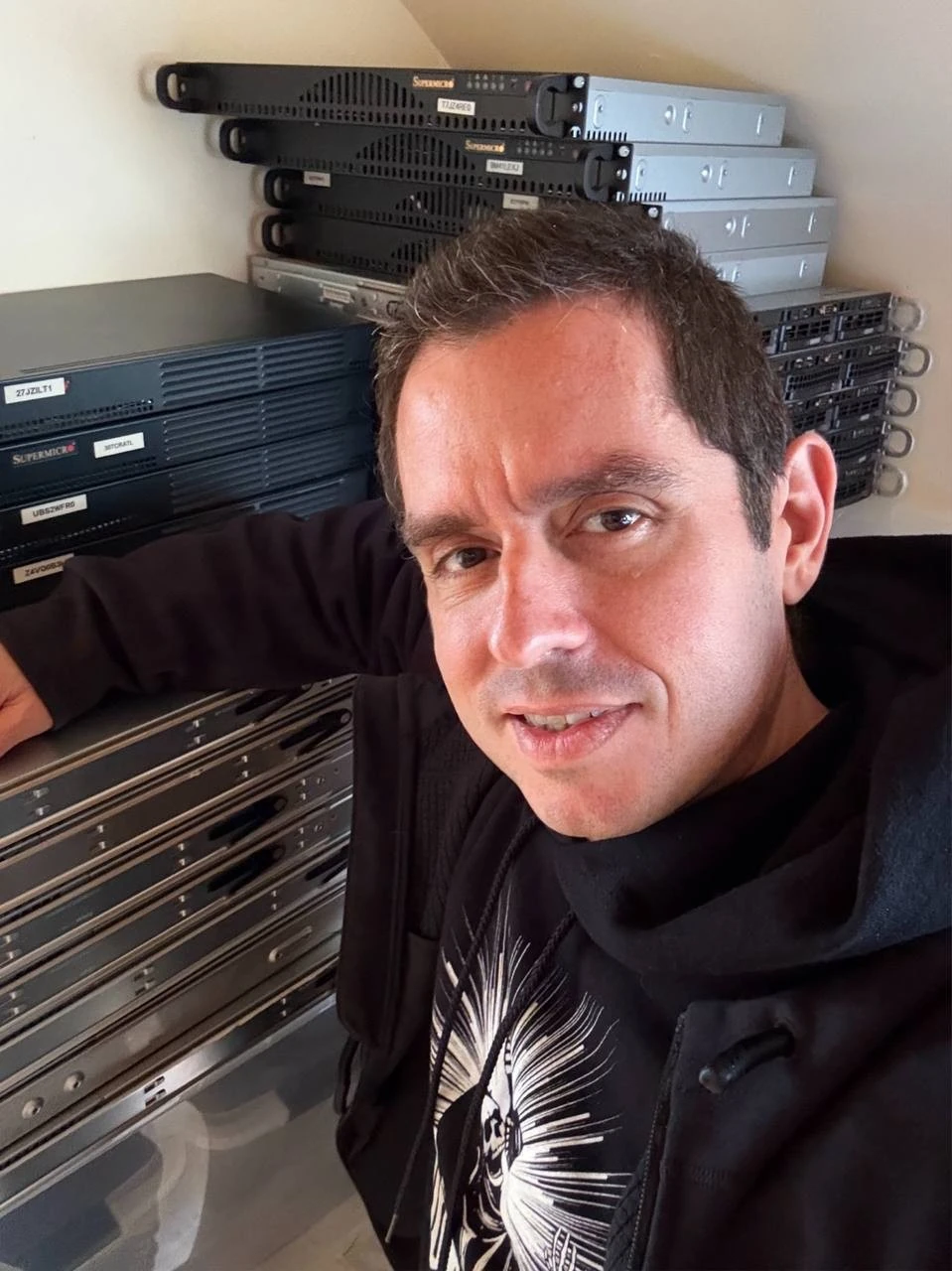
His background
About Christophe Casalegno
Christophe Casalegno is an entrepreneur, hacker and creator who has been known under the pseudonym Brain 0verride since 1986. He founded Digital Network in 1999 and subsequently developed a range of activities in IT, security, infrastructure, telecoms and digital services in Europe and the United States. He also spent four years running OVHcloud’s MIS (Managed IT Services) business.
Based in Ireland since 2015, he founded ScalarX that same year, a company focused on managed infrastructure, cloud and mission-critical services. In July 2026, ScalarX reported that it had exceeded €700,000 in ARR in Europe. The company develops products and services including StackX and ScalarCloud and is progressively transforming, in its founder’s terminology, into a “Singularity Company”: an organization designed to make humans, AI agents, tools, memory and execution systems work together.
Christophe Casalegno is also developing Elora, an independent, local-first strategic AI associate conceived as an operational memory and strategic continuity system. In parallel, he created Override Capital, an Irish family holding company dedicated to acquiring and developing infrastructure and technology-service businesses over the long term.
Following a diagnosis of Crohn’s disease in 2020, he also began a personal program focused on health, longevity, science and biohacking under the name Life 0verride. His current work therefore connects several recurring themes in his career: autonomy, technical robustness, independence, experimentation, family legacy and the search for new forms of execution leverage through artificial intelligence.