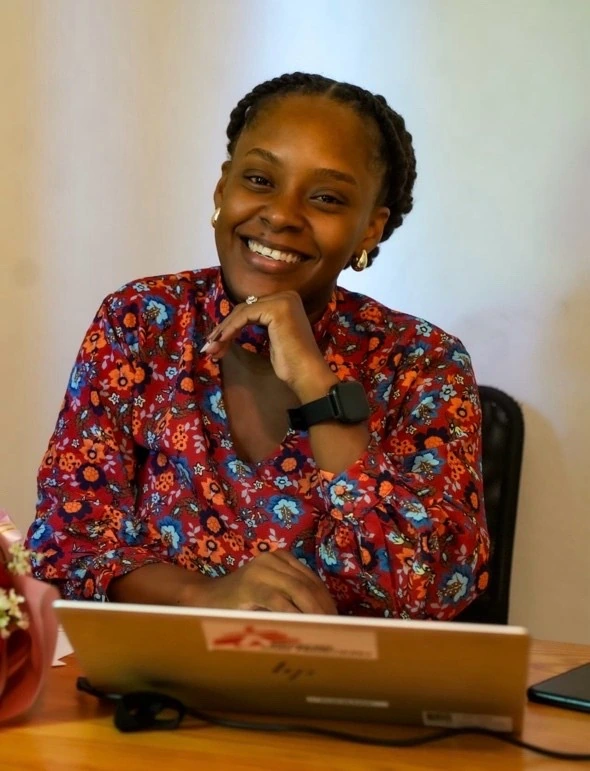
The interview
01
Commitment and the journey
JLPDécryptage
In 2020, while you were studying social communication at the Faculty of Human Sciences of the State University of Haiti, you were already a founding member and president of the Cercle des Étudiants Entrepreneurs d'Haïti. At the time, you presented entrepreneurship as a means of empowering young people, promoting education and helping to reduce unemployment. Behind those ambitions, there was already a desire to use communication as a lever for social transformation.
How did that initial desire to make an impact on society prepare you for your commitment to humanitarian work?
Djenane Baptiste
At the Faculty of Human Sciences of UEH, I understood that social change requires concrete and structured action. As co-founder and president of the Cercle des Étudiants Entrepreneurs d'Haïti, my aim was to take managerial and strategic action to give young people the keys to their own empowerment. Social entrepreneurship and humanitarian work share the same urgency: designing viable solutions where traditional systems fall short. Moving from co-creating initiatives for youth empowerment to humanitarian communication at MSF was a logical progression. In both cases, the dynamic remains the same: taking action on the ground to restore power, dignity and prospects to those whom crises try to make invisible.
02
The transition to humanitarian work
JLPDécryptage
Before joining Médecins Sans Frontières, you ran SM3, an organization devoted to marketing, multimedia and communication, while also taking part in several entrepreneurial initiatives. Since December 2022, you have been working as a Communications Officer with MSF in Haiti. The communication tools may sometimes be the same, but their purpose changes profoundly when the objective is no longer to promote an activity, but to report on a human reality with accuracy and responsibility.
What did you have to unlearn when moving from entrepreneurial communication to humanitarian communication?
Djenane Baptiste
I had to unlearn the reflex of visual performance and public "seduction" and replace it with a sense of absolute ethical responsibility. In marketing and entrepreneurship, as with SM3, the aim is immediate impact, perfect aesthetics and enhancing a brand. In humanitarian work, raw reality is not something to be sold; it is something to bear witness to. I had to learn to remove sensationalism in favor of nuance. The priority is no longer to promote MSF, but to document a medical and human situation accurately. The watchword is no longer "seduce", but "protect".
03
The ethical dilemmas of storytelling
JLPDécryptage
You lent your voice to an animation based on the anonymized testimony of a survivor of sexual violence in Haiti. The use of illustration, anonymity and an intermediary voice made it possible to make her story heard while protecting her identity. This kind of work is a reminder that in humanitarian communication, telling a story is not simply about informing people: it also means preserving the dignity and safety of those who agree to testify.
How can you embody a survivor's words faithfully without ever appropriating them?
Djenane Baptiste
Honestly, it was not easy. It is one of the most delicate and emotionally demanding exercises in my profession. Lending my voice to this survivor of sexual violence required a posture of complete humility and great psychological strength. To avoid appropriating her story, you have to position yourself strictly as a channel, a loudspeaker, and not as the author of the story. The use of animation and anonymity creates a healthy distance: the audience does not attach itself to my face, but to the universal truth of the testimony. To embody without appropriating means accepting the emotional weight of that voice, respecting its rhythm, silences and exact words, while remembering every second that behind the audio file there is a shattered human life trying to rebuild itself.
04
Trust and reputation
JLPDécryptage
At MSF, communication is not used solely to make an action visible: it contributes to bearing witness, to the organization's acceptance by communities and to understanding its mission. In Haiti, where insecurity has already led MSF to temporarily suspend some activities, trust becomes an essential condition for continuing to provide care. Reputation therefore goes far beyond the question of institutional image alone.
When trust determines the ability to carry out humanitarian action, where do you draw the line between protecting MSF's mission and preserving the trust that is essential to its work?
Djenane Baptiste
In a crisis context, reputation and trust are not abstract concepts: they are tools of protection on the ground. The boundary between protecting a medical mission and preserving public trust is not a dividing line; it is a constant balance. In humanitarian communication, our words must constantly reaffirm the fundamental principles of neutrality and impartiality in order to guarantee access to populations. The ethical boundary lies in being responsible for what we say: the point is not to conceal realities in order to protect an institutional image, but to measure the impact of every statement. The ultimate objective of a humanitarian communicator always remains the same: to make sure that today's communication choices do not close the door to tomorrow's relief and medical care.
05
Contemporary challenges
JLPDécryptage
Social media imposes stories that are increasingly fast, short and visual, while humanitarian crises require context, nuance and time. The arrival of artificial intelligence also opens up new possibilities for producing or distributing content, but it raises questions about the limits of automation when it comes to representing particularly vulnerable people and telling their stories faithfully.
In your view, what can never be entrusted to artificial intelligence in humanitarian communication?
Djenane Baptiste
Artificial intelligence can optimize our workflows, but it will never have a moral conscience or cultural empathy. AI can generate text or analyze data, but it is incapable of sitting face to face with a displaced mother in Port-au-Prince, decoding a look, feeling the weight of a silence, or capturing the nuances of dignity within distress. Humanitarian communication is based on a human-to-human connection. Entrusting the handling of vulnerability to an algorithm means risking the automation of suffering and dehumanizing those we serve. The ethics of testimony require a sensitivity that only the human heart possesses.
06
The transformative experience
JLPDécryptage
Since joining MSF, you have been working in a country where insecurity, population displacement and sexual violence have sharply increased humanitarian needs. In Port-au-Prince, monthly admissions related to sexual violence almost tripled between 2021 and 2025. Communicating in such a context means reconciling the urgency of bearing witness, the protection of people and factual accuracy, sometimes in situations where no choice is entirely satisfactory.
What situation you experienced at MSF has most profoundly transformed the way you communicate?
Djenane Baptiste
More than one single situation, it is the daily confrontation with stories of profound trauma and extreme vulnerability that has transformed my practice. Gathering the words of people affected by major crises forces an immediate change in perspective. I quickly realized that the urgency in humanitarian communication is not to seek visual impact or shock the public, but to help people understand the systemic dimension of crises. This reality pushed me to move from purely informative communication toward a testimony-based approach centered on dignity. The real transformation was understanding that every word shared must help explain the root causes of distress while protecting the integrity of those who live through it.
07
A personal reflection on the profession
JLPDécryptage
MSF's policy reminds us that a signed form, on its own, is not enough to guarantee truly informed consent. It emphasizes dialogue, the trust built with people and their right to retain control over how they are represented. This approach is a reminder that in humanitarian communication, professional convictions are sometimes tested by the reality on the ground.
Over the course of your experience, what certainty have you been forced to abandon?
Djenane Baptiste
I had to abandon the certainty that a "good story" or maximum visibility is always beneficial to the patient. At the beginning of my career, I thought that the more a situation was exposed, the more we helped to resolve it. The field taught me the opposite. Sometimes, media silence or absolute discretion are the greatest acts of protection that can be offered to a community. Informed consent is not a piece of paper signed in the heat of emotion; it is a dynamic process in which the patient must understand that they have the right to change their mind at any time, even if that cancels weeks of production work for me and my colleagues.
08
Legacy and transmission
JLPDécryptage
In 2020, you were already expressing the desire to contribute to Haiti's development by promoting education and youth autonomy. Your path has since led you into a profession in which the communicator often chooses to step back so that other voices can be heard. In this discreet but essential role, transmission is measured not only by the visibility of the person telling the story, but also by the mark left by the stories they help bring into existence.
When you look back on your journey in a few years, what story do you hope to have helped write?
Djenane Baptiste
I hope I will have helped write the story of a resilient Haiti, told from within by its own children, far removed from the miserabilist clichés of international media. I want people to remember that in the darkest moments of our recent history, Haitian professionals remained standing to care, bear witness and preserve humanity. If my time in humanitarian communication allows the voices of some survivors to have been heard with respect, and if I have been able to inspire other young Haitian communicators to embrace this profession ethically, then my story will have found its full meaning.

His background
About Djenane Baptiste
Djenane Madona Baptiste is a Haitian communications professional whose career spans entrepreneurship, social communication and humanitarian action. In 2020, while studying social communication at the Faculty of Human Sciences of the State University of Haiti, she was a founding member and president of the Cercle des Étudiants Entrepreneurs d’Haïti. That same year, Le Quotidien d’Haïti described her as the head of SM3, an organization dedicated to marketing, multimedia and communication, and as being involved in several entrepreneurial initiatives.
Through the CEEH, she also published articles on entrepreneurship, youth employment and digital transformation. Her career later moved into humanitarian work with Médecins Sans Frontières. MSF credited her photographic work in Haiti from December 2022, notably during the cholera vaccination campaign in Cité Soleil. In 2026, the organization again published her images in coverage from South Kivu in the Democratic Republic of Congo, including reporting on access to maternal and neonatal care and epidemic response.
Her work therefore sits at the intersection of field documentation, the ethics of testimony, the protection of vulnerable people and the transmission of stories produced as close as possible to the communities concerned.