ENGLISH VERSION
EL DIABLO
Introduction
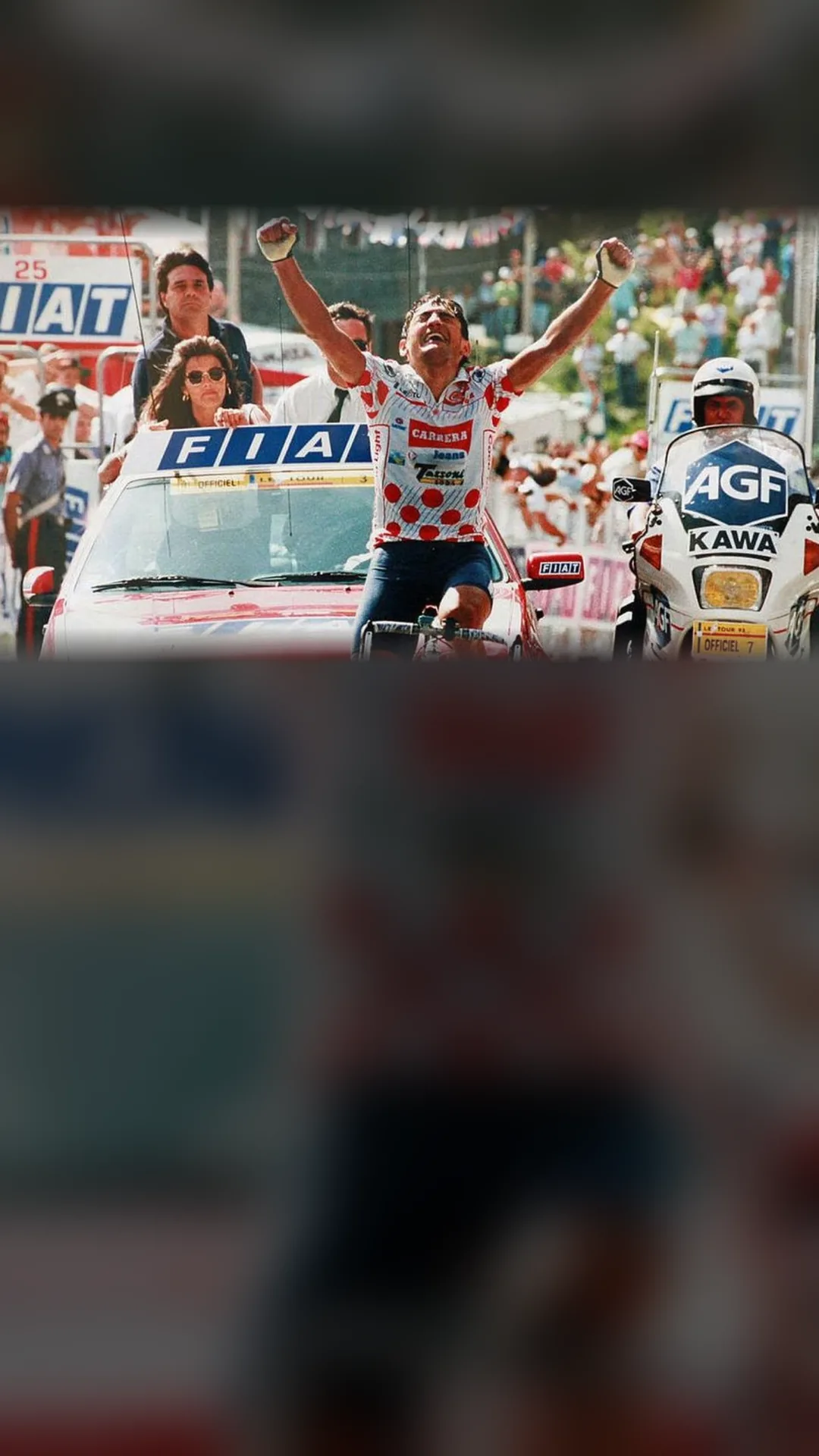
On 18 July 1992, Claudio Chiappucci won a Tour de France stage at Sestriere that became part of cycling folklore. Wearing the polka-dot jersey, “El Diablo” turned his instinct for attack into an unforgettable spectacle. Runner-up at the Tour in both 1990 and 1992, and winner of Milan–San Remo in 1991, the Italian helped define an era of duels with Greg LeMond, Miguel Indurain and Gianni Bugno. In this written interview for JLPDécryptage, he recalls the fear of being caught, his tactical gambles and the rivalries that shaped his career. He also reflects on his relationship with cycling today, the changes within the peloton and the legacy he hopes to leave beyond the podium.
THE CAREER
01/ 08
JLPDécryptage
In 1992, you had reconnoitred the Sestriere stage several months in advance, at a time when this kind of preparation was still unusual. Yet you later said the breakaway came about almost by chance. At what point did you realise that day could become far more than just another attack?
Claudio Chiappucci
I had prepared that stage because I wanted to win it, but I could not have imagined I would achieve something that would go down in history. I was very tense at the start. I had been waiting for that day for months; my adrenaline was sky-high. I did not want the race to slip through my fingers. When I dropped Virenque on the Iseran, I found myself alone. That was where I decided the fate of the stage. Then came the fear of being caught at Sestriere. For me, the final kilometre was a moment of triumph, amid an enormous crowd.
02/ 08
JLPDécryptage
Against Miguel Indurain, whose superiority in time trials you knew well, you understood that waiting until the final kilometres would not be enough. When you face a rider who is so hard to beat, how do you decide when to stop calculating and accept the risk of losing everything?
Claudio Chiappucci
To challenge Indurain, I had to reinvent myself as a rider. I had realised that, if I wanted to put him in difficulty, I also had to isolate him from his team. The timing depended on the race situation. Sometimes that meant making a move from a long way out, as at Sestriere. The result alone was not enough: I wanted the overall classification.
03/ 08
JLPDécryptage
You arrived at the 1990 Tour de France without being regarded as one of the main favourites, yet found yourself defending the yellow jersey against Greg LeMond until the final days. Did that experience reveal something about yourself that you had not yet discovered in your role as a domestique?
Claudio Chiappucci
Yes. I went to that Tour to find out whether I could compete for the top places in the Grand Tours, particularly because I had felt good at the Giro d’Italia. I had asked my team to give me that opportunity. The problem was that I did not expect to wear the yellow jersey at that Tour. Neither my team nor I were prepared.
04/ 08
JLPDécryptage
You have often spoken of your difficulty understanding Gianni Bugno’s role in the chase behind you towards Sestriere. You have since re-established a relationship without really revisiting that day together. Looking back, does that episode also say something about the rivalry between the great Italian champions of your generation?
Claudio Chiappucci
Certainly. That day, if Gianni had fought against Indurain without cooperating, many things would have changed. But of course he was on another team and was riding his own race. At that time, our rivalry was strong. Together, Indurain would not have won as much.
CLAUDIO CHIAPPUCCI TODAY
05/ 08
JLPDécryptage
In your book published in 2025, you write that you no longer ride in pursuit of performance, but to feel free. After so many years in which your life was measured by results, how has that freedom changed your relationship with the bicycle?
Claudio Chiappucci
Before, I had to pursue results. It was my job and I wanted to give the best of myself. Then came the time to continue enjoying my passion for sport in a different way: for wellbeing, and to share moments and experiences with the many fans.
06/ 08
JLPDécryptage
Today you speak to business leaders about leadership and also help train young cyclists. What did your career actually teach you about leadership that cannot be learned from a book or at a business school?
Claudio Chiappucci
To get to where I got, you have to fight and never give up, because things do not always go well. I have never set limits for myself. Everything I do is driven by an intense passion and the desire to keep improving. Being a leader matters, but so does knowing how to bring a group together.
07/ 08
JLPDécryptage
You recently said you were impressed by Tadej Pogačar’s ability to dominate while showing few signs of suffering. Beyond Pogačar himself, have today’s performances changed the way you watch and understand elite cycling?
Claudio Chiappucci
I am aware that technology has changed the world of cycling, and not only cycling. I come from an era when I did everything: I was an athlete, a manager and a public-relations person all at once. Instinct... All that has been lost. Today, people rush through the stages of development. Careers are shorter and more intense.
08/ 08
JLPDécryptage
You still ride, attend events, appear in the media and pass on your experience. After spending so many years trying to leave your mark on races, what mark would Claudio Chiappucci like to leave today, beyond the results sheets?
Claudio Chiappucci
I have always taken great care of my relationship with the fans. People fell in love with my way of racing, with the way I interpreted cycling. They waited for my accelerations, my attacks, and I could feel that during the race. As I always say, it is not the steps you take that count, but the footprints you leave behind. And my exploits have taught people never to give up, even when it seems impossible.
ABOUT CLAUDIO CHIAPPUCCI
Born on 28 February 1963 in Uboldo, Lombardy, Claudio Chiappucci is a former Italian professional cyclist known as “El Diablo”. His attacking style and long-range moves made him one of the defining figures of cycling in the 1990s.
He came to widespread attention at the 1990 Tour de France, spending eight days in the yellow jersey before finishing second to Greg LeMond. He reached the Tour podium again in 1991 (third) and 1992 (second). His Tour record includes three stage wins — Val Louron (1991), Sestriere (1992) and Pau (1993) — and two King of the Mountains titles (1991 and 1992). His long solo-winning move to Sestriere on 18 July 1992 remains the emblematic image of his audacity.
At the Giro d’Italia, he finished second in 1991 and 1992 and third in 1993. He also won the Giro points classification in 1991 and its mountains classification in 1990, 1992 and 1993. His major victories include Milan–San Remo (1991), the Tour of the Basque Country (1991), the Clásica de San Sebastián (1993), the Volta a Catalunya (1994) and three successive Japan Cups (1993–1995). In 1994, he took silver in the road race at the World Championships.
In 2025, he published « Claudio Chiappucci. I luoghi del Diablo » (DFG Lab) with Federico Vergari, recounting his life and the places that shaped his journey. He continues to share his experiences of cycling, as he explains in this extended interview.
