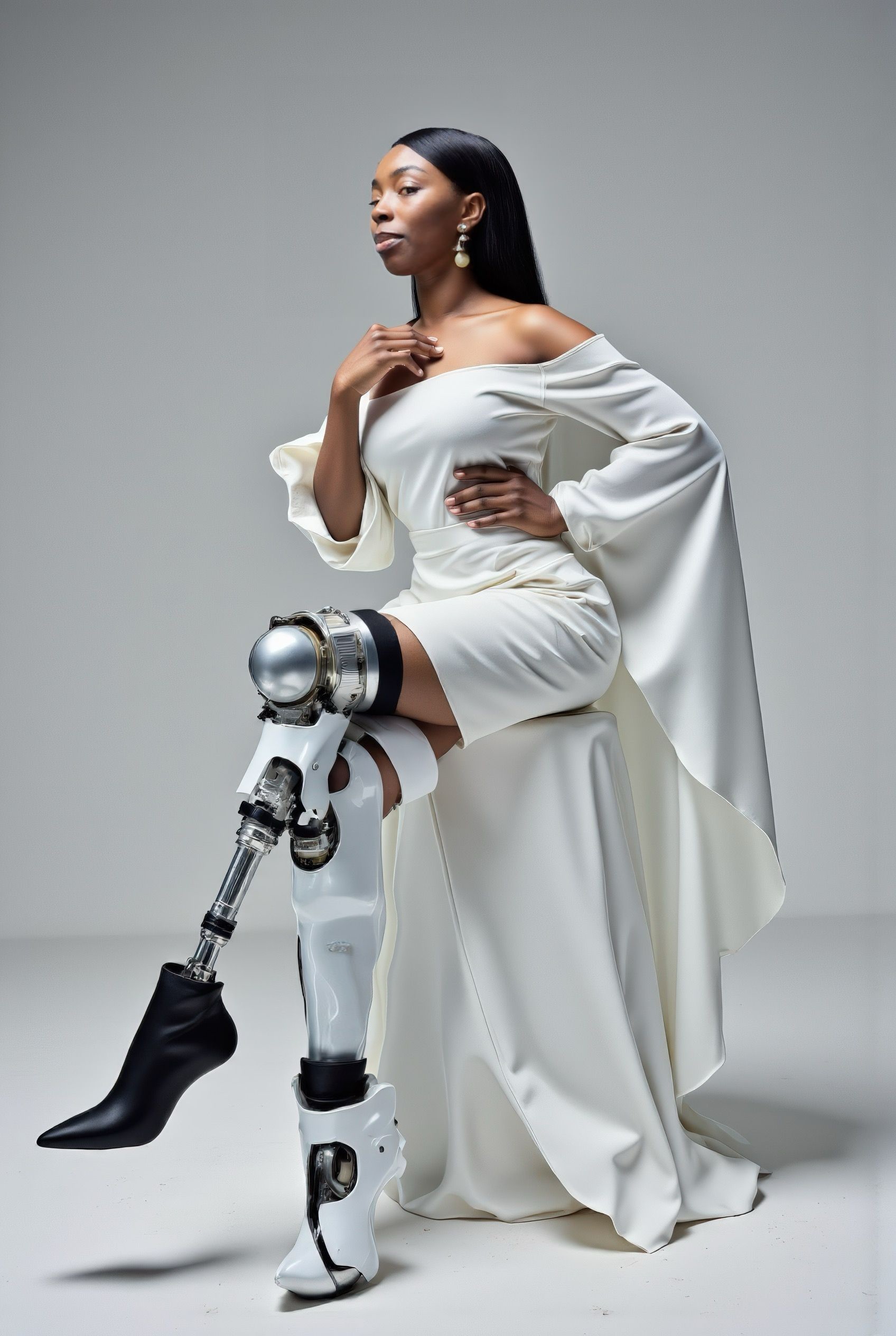
Eva Chisom Chukwunelo in a white dress, her leg prosthesis visible

International in-depth interview · Nigeria

Eva Chisom Chukwunelo

Who designs the world for different bodies?

Prosthetics, representation, African technological sovereignty, memory and artificial intelligence.

Français English

Introduction

A prosthesis promises movement. It can also reveal a geography of power. When its silicone liner traps sweat in Nigeria’s heat and humidity, when its components were designed for other climates, when the available shades fail to reflect the diversity of African skin tones, the device no longer tells only a medical story. It reveals where technology is conceived, for which bodies, according to which standards—and at what price. An investigation published by HumAngle documented this reality among several Nigerian amputees: devices that make walking possible, yet whose design can simultaneously limit wear time, comfort, or the sense that the prosthesis belongs to one’s body.

Eva Chisom Chukwunelo knows this contradiction from within. As a teenager, she lost a leg following osteomyelitis, a serious bone infection, as she told Premium Times. This fact illuminates her path, but it does not define it. What matters lies elsewhere: in the way an individual experience becomes an instrument for analyzing the systems that organize mobility, the gaze, memory, and access to progress.

She explains that she hid her prosthesis for a long time before beginning to make it visible. This exposure of the body could take the form of what she calls a “visual rebellion”: a direct response to representations that still associate disability with dependence, compassion, or erasure. But Eva Chukwunelo immediately rejects the opposite trap. Showing her leg does not mean that every outfit, every photograph, or every gesture must become an activist statement. The right to be visible also includes the right not to be continually turned into a symbol. She claims a freedom more demanding than representation alone: the freedom to be seen without being appropriated by the gaze.

This tension runs through The Body as Canvas, a cultural project she describes as a work of storytelling, photography, fashion, film, and the archiving of disabled lives. In the text in which she sets out its vision, bodies are neither objects of pity nor permanent heroic figures. They may embody beauty, desire, power, fragility, or the ordinary. The aim, then, is not only to change contemporary images of disability, but to prevent entire lives from disappearing from the archive. Memory is political: a society also reveals who matters through the lives whose traces it chooses to preserve.

Her work has gradually traveled beyond Nigeria. In 2024, she was selected for the Mandela Washington Fellowship, in the Leadership in Civic Engagement track at Florida Gulf Coast University. In March 2025, she spoke in New York at a high-level dialogue during the 69th session of the United Nations Commission on the Status of Women, where the official UN records list her as an Amputee Peer Counselor. That same year, her TEDxLagos talk extended her reflection on the bodies that history considers—or does not consider—worthy of remembrance. These milestones do not form a record of achievements. Rather, they mark the passage of lived experience into spaces where public policy, culture, and collective imagination are debated.

But representation is only one part of her reasoning. Her experience in the prosthetics sector leads her to examine the material economy of inclusion. In her responses to JLP Décryptage, she describes a Nigerian market dependent on numerous imported components, whose final price absorbs taxes, transport, customs clearance, currency fluctuations, and operating costs. Yet she does not cast companies, international organizations, or donors as convenient adversaries: their interventions currently allow some people to access equipment that would otherwise be unaffordable. The real tension lies between the urgency of meeting present needs and the necessity of building future autonomy.

Should Africa remain primarily a user of assistive technologies designed elsewhere, or can it become a center for research, manufacturing, and export? For Eva Chukwunelo, an innovation does not become African because a flag is added to it. It becomes African when it starts from real uses: climate, skin pigmentation, infrastructure, maintenance, proximity to technicians, purchasing power, and access to care. This requires persons with disabilities to be involved not after the design is complete, but from the outset alongside engineers, universities, manufacturers, and public decision-makers.

This demand takes on new significance in the age of artificial intelligence. Intelligent prostheses, robotics, neural interfaces, screen readers, and voice navigation open up considerable possibilities. But technology always reproduces part of the data, priorities, and blind spots of those who develop it. When certain people are absent from laboratories, datasets, and decisions, their exclusion may no longer belong only to society: it can become embedded in the very operation of the tools intended to prepare the future.

This is the ground on which this in-depth interview with JLP Décryptage begins. It is not centered on a woman reduced to what she has supposedly “overcome,” but on a body of thought taking shape at the intersection of the body, industry, culture, and technology. Behind every question, the same inquiry emerges: who designs our shared world, and who finally has the right not only to be included in it, but to draw its plans?

01 — When Advocacy Meets Entrepreneurship

JLP Décryptage

You have often explained that people living with limb loss face a paradox: their independence depends on technologies that remain financially out of reach for a large part of the population. At the same time, your own work relies on partnerships, funding and collaborations with organizations operating within that very ecosystem.

How do you preserve your intellectual independence when your advocacy intersects with the economic interests of those who develop or finance these solutions? Where do you draw the line between meaningful collaboration and the commercial appropriation of the cause you defend?

Eva Chisom Chukwunelo

My understanding of this question comes partly from working in the prosthetics space myself. When I worked in a prosthetic facility, I started asking questions about why these devices cost so much, and I learned that the cost is connected to so many factors. In Nigeria, many of the components used in prosthetic fabrication are imported, so there are tariffs, taxes, shipping costs, clearance fees, currency fluctuations, and then just the general cost of running a business. Most prosthetic facilities in Nigeria are privately operated, and I understand that they can't continuously provide devices at a loss and expect the business to survive. That understanding has actually made my advocacy more nuanced than it might be if I hadn't worked in that space.

I advocate strongly for prosthetic care to become more affordable and accessible, but I also understand the realities faced by the people currently providing these services. Many of them are working within a difficult economic system, and I don't want to oversimplify their situation. But where I think we need to look deeper is our dependence on importation. If a component is produced in Europe, Asia or somewhere else and has to travel to Nigeria before it reaches a user, the final cost reflects that entire process. So for me, the long-term conversation has to include local research, local manufacturing and stronger investment in African professionals.

I also believe government has a major responsibility here. Assistive technology can determine whether someone is able to work, go to school, move independently or participate fully in society. I would like to see prosthetic and orthotic care properly incorporated into health insurance systems so people aren't expected to pay the entire cost of a device or replacement component from their personal income.

At the same time, I'm very open to international collaboration. There are people in the Global South who are walking today because organizations and individuals in other countries donated prosthetic components that they could never have afforded. That support matters. My concern is sustainability. If donations become the only model we have, we remain dependent on what another country has already designed, produced or decided to give us. I see donations as something that can help people today while we work towards stronger systems for tomorrow. I'm also not against importing components. If someone needs a prosthesis today and the best available component is coming from another country, I would rather that person receive the support they need than wait for an African manufacturing ecosystem to become perfect.

My advocacy is really about asking what happens next. How do we get to a point where African professionals have the resources, research funding, equipment and exposure to create solutions here? We have engineers, we have prosthetists and orthotists, we have technicians, we have researchers, we have students graduating from these fields. We have people with disabilities who understand the problems because they live with them. There is talent here. What I think is missing is enough investment, resources, research and opportunities for collaboration. I'm also very interested in collaboration between Africa and the rest of the world. I think there is so much we can learn from countries that have had decades of research and development in this field, but I want that knowledge exchange to move in both directions. African professionals can learn from international experts, and international experts can learn from African professionals who understand African users, African climates, African infrastructure and African realities.

When I work with organizations, I want to be able to maintain my ability to ask difficult questions. I want to be able to say, "This is working," or "This isn't working for the people we are trying to serve." Funding should never determine what I am allowed to believe or say. I don't have all the answers—I'm still learning what meaningful collaboration looks like as I move through this space. But I know that I want partnerships where the people affected by the problem actually benefit from the collaboration.
02 — Building Technology Designed for Africa

JLP Décryptage

You have repeatedly pointed out that most prosthetic technologies available today were designed for climates, body types and daily realities that do not always reflect the African experience.

Beyond identifying the problem, what would truly African-designed prosthetic innovation look like? Which actors—engineers, manufacturers, universities or public institutions—should play the decisive role in creating a new generation of assistive technologies adapted to the continent?

Eva Chisom Chukwunelo

When I imagine African-designed prosthetic innovation, I don't simply imagine taking an existing prosthetic and putting an African flag on it. I imagine starting with the realities of the people who are actually going to use the device. Climate is one example. In Nigeria, heat and humidity are part of everyday life. I personally know what it can feel like to use a silicone liner in a humid environment. The heat and sweat can become extremely uncomfortable. Your leg can feel like it is swimming inside the liner, and that can affect how long you are able to wear the prosthesis and how far you can walk. That's a design issue that should have been considered from the beginning.

Then there's maintenance. What happens when a component breaks? Can the user find the replacement locally? How long will they have to wait? How much will it cost? Is there a technician nearby who understands the component? There are also questions about our roads, transportation systems, electricity, access to healthcare and the realities of moving around Nigerian cities. All of those things should influence design. They're not minor concerns, they're central to whether the device actually works in someone's life.

Then there's representation. Many prosthetic components do not adequately reflect the range of African skin tones. Someone with a darker complexion may receive a prosthetic foot or cosmetic covering that is visibly much lighter than their skin. Some people may not care about that. Some people care deeply. I think people should have the choice. I also think there's a creative opportunity here. Why can't prosthetic devices become a form of cultural expression? Why couldn't someone choose an African print, a color, a pattern or something connected to their culture? Africa is incredibly diverse and colorful. Someone might want their prosthetic socket to carry an Igbo pattern. Someone else might want Ghanaian kente-inspired elements. Someone else might want the Nigerian green and white. Someone might simply want pink or green because that's what they like. Assistive technology can be functional and expressive.

But African innovation has to go much deeper than aesthetics. We sometimes design things for disabled people without designing with disabled people, and that's the real problem. The people using prostheses or orthotics need to be part of the research and development process from the start. Prosthetists and orthotists understand the clinical side. Technicians understand fabrication. Engineers understand materials and mechanics. Universities can provide research capacity. Manufacturers can help take ideas into production. Governments can provide policy and funding. And users can tell everyone what happens when the device leaves the laboratory and enters real life. That perspective is invaluable.

I would like to see researchers asking users the questions that actually matter: What hurts? What breaks? What makes you uncomfortable? What makes you stop wearing your prosthesis? What can you afford? What would make you want to wear it every day? What do you wish your prosthesis could do? Those conversations should happen before a product reaches the market, not after. There are people who eventually abandon prosthetic devices because their experience becomes painful, uncomfortable or impractical. We need to understand those experiences.

I also don't believe African innovation means closing ourselves off from the rest of the world. I want collaboration. I want African professionals to learn from people who have decades of experience. I want knowledge to move between continents. I want African professionals to bring those learnings home and combine them with what they know about African users. The goal, for me, is eventually for Africa to become a producer of assistive technology. We should be able to develop products here, improve them here, test them here and eventually export them. I don't have the blueprint for how we get there, but I think the first step is accepting that the people who use these devices deserve a seat at the table from the beginning.

03 — The Body as a Language

JLP Décryptage

You use fashion, photography and the presentation of your own body not only as forms of artistic expression but also as powerful communication tools.

At what point did you realize that your body itself could become a political language? Do you see a boundary between personal expression, artistic performance and advocacy, or have these dimensions become inseparable in your work?

Eva Chisom Chukwunelo

I had my amputation in 2012, and for many years I tried very hard to hide it. I wore socks. I wore long clothes. I became very conscious of how I moved and how much of my body people could see. I was afraid of people knowing that I was disabled. Looking back, I think hiding became a way of trying to protect myself from rejection. It affected my confidence and the way I expressed myself. There was a period where I felt like I couldn't fully become myself because I was constantly thinking about what people would think if they saw my leg.

When I eventually started showing my prosthesis, something changed. I realized that my body could communicate something before I had said a single word. People who had never thought about prosthetic technology suddenly had questions. People who didn't understand that someone could lose a limb and continue living, working, dressing well and participating in society began to see it. I started seeing visibility as a form of visual rebellion. Society often tells disabled people to hide. So sometimes simply being visible becomes a statement. I remember being in spaces where disabled people were physically absent, and I would walk in wearing my prosthesis visibly. My presence would make people realize that there were people like me who should also be part of that space.

But I also want to make an important distinction here. I don't show my prosthesis every time because I'm advocating. Sometimes I'm simply getting dressed. Sometimes I want to wear shorts because I like shorts. Sometimes I want to show my leg because I like how I look. Sometimes I want to cover it because I don't feel like talking about disability or the attention it demands. That choice belongs to me. If I show my disability, people shouldn't automatically decide that I'm making an advocacy statement. If I cover it, people shouldn't automatically decide that I'm ashamed. It's my body, and the autonomy over that matters

Fashion and photography have given me a way to explore this. I've seen how photography and fashion can influence how people think about gender, race, skin color, body size, class and culture. I believe disability can also be represented differently. People with disabilities don't always have to be presented as tragic or inspirational. Sometimes we are just people. We want to dress well. We want to date. We want to work. We want to dance. We want to take pictures. We want to go to parties. We want to be ordinary. And sometimes we want to make a statement. For me, those things can exist together. I can be advocating while taking a photograph, and I can also simply be Eva taking a photograph. I'm still learning where the boundaries between those things are.

04 — Recognition from Abroad

JLP Décryptage

Your work received international recognition before becoming widely acknowledged in Nigeria.

How do you explain this gap? Do you believe that African innovators still need international validation before they are fully heard in their own countries, or do you see this dynamic beginning to change?

Eva Chisom Chukwunelo

This is something I've asked myself many times, and I honestly don't have one definitive answer. There was a point where I realized that people outside Nigeria were paying attention to my work in ways I didn't expect, while many people within Nigeria still didn't know who I was. And that felt strange. It also felt lonely. I wanted to build community at home. I wanted to connect with people having these conversations in Nigeria. Yet, in some ways, it felt easier to connect internationally. Part of it may have been the networks I gained through the Mandela Washington Fellowship. Being part of an international fellowship placed me in rooms where people were willing to listen to ideas I was still developing. It gave me exposure, but it also gave other people a reason to pay attention to my work.

I also think there's something about how recognition works. Sometimes when people hear that someone has received international recognition, they begin to look at that person differently. It can feel like external recognition becomes evidence that the person is worth listening to. I think that's something we need to question as a society. At the same time, I don't want to say that Nigeria doesn't appreciate its people. That would be unfair. Nigeria has so many incredible disability advocates, researchers, entrepreneurs and creatives. Some have been doing this work for decades.

I also have to acknowledge my own position. I didn't start with a huge organization behind me. Much of my work began informally through speaking, writing, volunteering, having conversations and showing up. I only formally registered my organization in 2025. So structure may have played a role too. I'm still trying to understand what happened and why the timeline worked out the way it did.

One thing I do know is that I don't want international recognition to become the destination. If people outside Nigeria see value in my work, I want that visibility to help me create deeper conversations and opportunities within my own community. I owe a lot to the people and networks that have supported me internationally, and I'm grateful for them. At the same time, I want my work to mean something to the person in Nigeria who has never heard of me. I don't want to build something that looks impressive internationally and feels disconnected from the people around me.

And I also want to be honest about where I am. I haven't "made it." There are still many people in Nigeria who don't know me. There are communities I haven't reached. There are things I haven't built yet. So I'm asking myself a different question now. What can I do with the visibility I have received? How can I use it to build something useful at home? That's something I'm still figuring out.

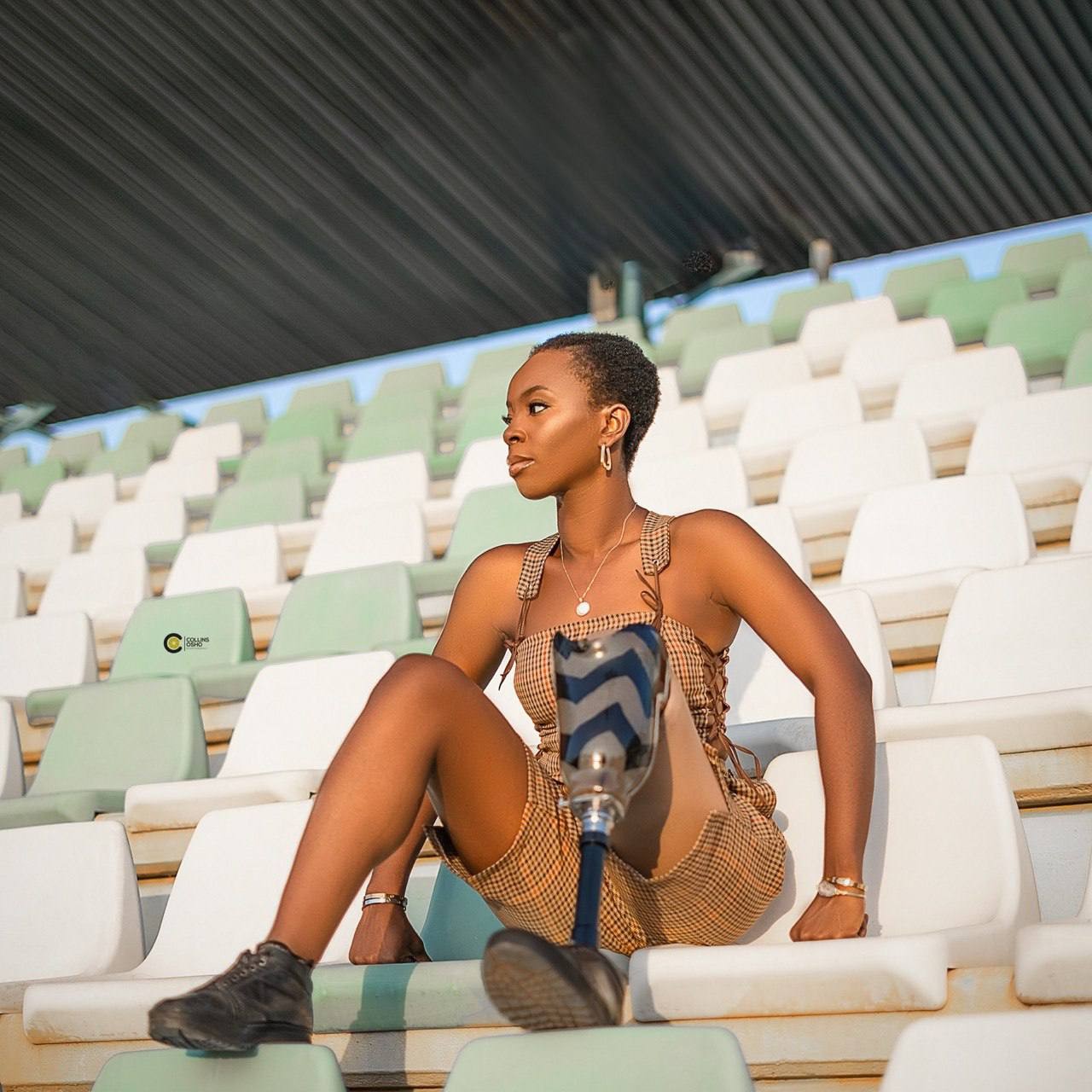
Eva Chisom Chukwunelo sitting alone in stadium stands, her leg prosthesis visible
“I started seeing visibility as a form of visual rebellion.”
Eva Chisom Chukwunelo

05 — When a Cause Becomes an Identity

JLP Décryptage

You have said that your advocacy cannot be separated from your personal life because it is rooted in your own lived experience.

Over time, how do you prevent this public identity from becoming a cage? Are there aspects of Eva Chukwunelo that the public never gets to see because so much attention is focused on your role as an inclusion advocate?

Eva Chisom Chukwunelo

This question is probably the closest to where I am in my life right now. I've recently realized that I don't want "disability advocate" to be the only way people introduce me, and it happens often. Someone introduces me at an event and says, "Eva is a disability advocate." I understand why. It's accurate. But sometimes I think, "Is that really all I am?"

I'm a creative. I love storytelling. I love art. I want to create things. I want to build spaces where people can experiment and create. One of my dreams is to build an institute where people can learn storytelling, artistic expression and innovation, and where people from different backgrounds can come together and create. I love cooking, and I genuinely want to have a restaurant someday. I sing. I dance. I used to draw. I love games. I love parties. I love wine. I have a funny side that probably doesn't appear during professional conversations. I have dreams that have nothing to do with disability.

I am a church girl who also has ordinary struggles. I have insecurities. I have things I'm still learning. I have relationships and friendships. I cry. I have things I want to improve about myself. I don't have everything figured out. Sometimes I think people expect disabled people who advocate publicly to have a perfect life because we're constantly presented as examples of resilience. I don't want to be an example all the time. I want to be a person. My disability is part of my story, but there's so much more to my story.

I want to create. I want to build businesses. I want to make art. I want to tell stories. I want to have fun. I want to fall in love. I want to experience life. I want to make mistakes. I want to change my mind. I want to discover things about myself. I want to go skydiving. I think that's the freedom I'm trying to find now. I want to be able to say, "Today I want to talk about disability." And tomorrow I might say, "Today I just want to create." I don't know exactly what my identity will look like ten years from now. But I know I want people to see Eva as a whole person.

06 — Who Really Defines Inclusion?

JLP Décryptage

Over the past few years, companies, institutions and global brands have embraced the language of diversity and inclusion with unprecedented enthusiasm.

In your view, how can we distinguish genuine commitment from a communication strategy? What objective criteria should we use to determine whether an organization is truly improving the lives of people with disabilities rather than simply improving its public image?

Eva Chisom Chukwunelo

For me, the simplest test is: don't tell me you are inclusive. Show me. Inclusion is very attractive when it's a campaign. It looks good on a billboard. It looks good on LinkedIn. It looks good in a report. It looks good during International Day of Persons with Disabilities. But inclusion becomes much more serious when it requires money, changes to infrastructure, changes to policies and changes in behavior.

I've worked in environments where people spoke proudly about being inclusive and caring about people with disabilities, and then practical accessibility issues came up and the reality was different. That taught me something important. An organization can have inclusive language without having an inclusive culture. So I look at what happens when nobody is taking photographs. Does the organization hire people with disabilities? Does it pay disabled professionals fairly? When a disabled employee needs an accommodation, does the organization ask what they need? Does it actually provide it?

I also look at the physical environment. Is it accessible? Are the websites and digital platforms accessible? Are disabled employees involved in decision-making? Or are they invited after all the important decisions have already been made? And are persons with disability treated as professionals? If a company normally pays a designer ₦100,000 for a particular job, the designer with a disability should receive the same professional payment for that work, while also getting accessibility accommodations. Hiring a person with a disability isn't a favor. The organization also needs to consider the accommodations that allow that person to work effectively. A visually impaired employee might need certain technology. A deaf employee might need captioning or interpretation. Someone with a physical disability might need changes to the physical workspace. The specific needs will differ from person to person. So ask. Listen. Provide what is needed. Then treat the person as a professional.

I also think organizations need to examine what happens after the campaign ends. You can celebrate persons with disabilities on December 3rd and then return to an inaccessible workplace on December 4th. That tells me much more about your organization than the campaign did. I don't think organizations need to be perfect. Accessibility is something many organizations are still learning about. There's a difference between not knowing and refusing to learn. If you genuinely care, you ask questions. You listen. You learn. You make mistakes. You correct them. You keep improving. And I think persons with disability should have a voice in evaluating organizations too. Sometimes the most useful question isn't "What does your report say?" It's "What do the staff with disabilities who work with you say about their experience?" That's where I would start.

07 — The Memory of Bodies

JLP Décryptage

In your TEDx talk, you introduced a powerful idea: a world where every body is considered worthy of being remembered.

Why do you see memory as a political issue just as important as accessibility or representation? And how can we preserve and tell the stories of people with disabilities without reducing them solely to their disability?

Eva Chisom Chukwunelo

I think one of the easiest ways to make someone disappear is to never tell their story. If there are no photographs, no records and no stories passed from one generation to another, eventually it can feel as though that person never existed. That idea became very real to me when I started thinking about what my life might have looked like if I had been born generations ago, in the ancient Igbo community, before modern prosthetic technology and contemporary disability rights conversations. I couldn't find enough stories. There were assumptions. There were fragments. But where were the ordinary stories?

Were there people with disabilities who became parents? Farmers? Artists? Leaders? Traders? Lovers? People who were difficult? People who were kind? People who were successful? People who were rejected? People who simply lived ordinary lives? We don't know enough. That's why I think memory is political. What a society chooses to document tells us who it considers worthy of being remembered. We preserve the stories of kings, politicians, wars and major historical events. We remember people who accumulated power. We remember people who achieved extraordinary things. Sometimes we even remember people who committed terrible acts. So why shouldn't we preserve the stories of disabled people?

And I don't want those stories to be turned into perfect inspirational narratives. I want the whole human being. The person who struggled. The person who fell in love. The person who had children. The person who failed. The person who was angry. The person who achieved something extraordinary. The person who lived an ordinary life. Disability doesn't automatically make someone good, heroic or inspirational. Disabled people are complicated human beings just like everyone else. That's the kind of storytelling I want to see.

It's especially important in Africa because so much of the disability history we encounter comes through Western frameworks. We need to ask what disability looked like within our own cultures. What happened to disabled people in our communities generations ago? Were they protected? Were they excluded? Were they celebrated? Were they hidden? Did they hold positions of authority? Did they own land? Did they have families? We don't know enough. Some of those answers may be uncomfortable. I still think we need to know them. History doesn't have to be comfortable to be worth preserving. I believe people with disabilities deserve to be remembered because they were people who lived. That's part of what motivates my interest in storytelling and projects like The Body as Canvas. I want us to leave records behind. Human records. Real records. Stories that show the full range of human experience.

08 — The Future of Disability in the Age of Artificial Intelligence

JLP Décryptage

We are entering an era in which artificial intelligence, robotics, neural interfaces and assistive technologies are evolving at an unprecedented pace.

Twenty years from now, do you believe that the greatest barriers will still be technological, or will they primarily be cultural? If you could leave one message for the engineers, policymakers and creators shaping that future, what would it be?

Eva Chisom Chukwunelo

I'm genuinely excited about what technology could make possible for disabled people. I think about prosthetics, captions, robotics, AI, smart devices, neural interfaces and everything that's being developed, and I see enormous possibilities. But I also think technology reflects the people who create it.

There's a thought process I have called The Village Square. In many traditional Igbo communities, the village square is a communal space. People gathered there to meet, talk, settle disputes, celebrate, trade, make friends, play, eat and participate in community life. It was supposed to belong to the community. But I sometimes wonder: what happens if the village square isn't accessible to everyone? If I couldn't walk there, could I participate? If I couldn't hear, could I participate? If I couldn't see, could I participate? If I communicated differently, would the village square still belong to me?

Technology can become a bridge between people and the spaces where society happens. Captions can allow deaf people to participate. Prosthetic technology can allow some people with limb loss to move through spaces more easily. Screen readers can allow blind people to access information. Smart devices can create new forms of communication and independence. The possibilities are huge. But technology also carries the assumptions of the people creating it. AI is trained on data. Products are designed according to assumptions. Engineers decide which problems deserve attention. Researchers decide what questions to investigate. Companies decide where to invest. Policymakers decide who receives support. If persons with disabilities are absent from these processes, that absence can become part of the technology itself.

So my message to engineers, policymakers, researchers and creators is simple: don't build the future for us without us. Bring persons with disabilities into the room when the idea is still an idea. Bring us into the research. Bring us into the design. Bring us into testing. Bring us into policy discussions. Pay us for our expertise. Don't wait until the product is finished and then ask whether disabled people can use it. And disability is diverse. A wheelchair user may have different needs from a blind person. A deaf person may have different needs from someone with limb loss. Someone with an intellectual disability may have different needs from someone with a physical disability. So there needs to be diversity within disability representation too.

I also think we need to reconsider the idea that technology will eventually eliminate disability. People are born with disabilities. People become disabled. People age. People become sick. Accidents happen. Human bodies change. Technology can help people live better, move better, communicate better and participate more fully. That's a beautiful thing. But I don't think the goal should be to make disability disappear. The goal should be to create a society where different bodies can belong. And this is where culture becomes very important. If society continues to discriminate against disabled people, we could create incredibly advanced technology and still leave people behind.

The people creating the technology need to understand disabled people as human beings. They need to see our bodies. They need to hear our stories. They need to understand our lives. They need to involve us in the process. And I want African voices in that future too. I don't want Africa to arrive twenty years from now as a consumer of technologies designed somewhere else. I want African engineers, researchers, creatives, prosthetists, users and policymakers sitting at the table. I want us designing. I want us researching. I want us experimenting. I want us exporting ideas. I want African disabled people helping shape what the future of disability looks like. I don't know exactly what that future will look like. I'm still learning. I'm still asking questions. But I know I want disabled people to help build it. Because the future of disability should include the people who will actually live in it.

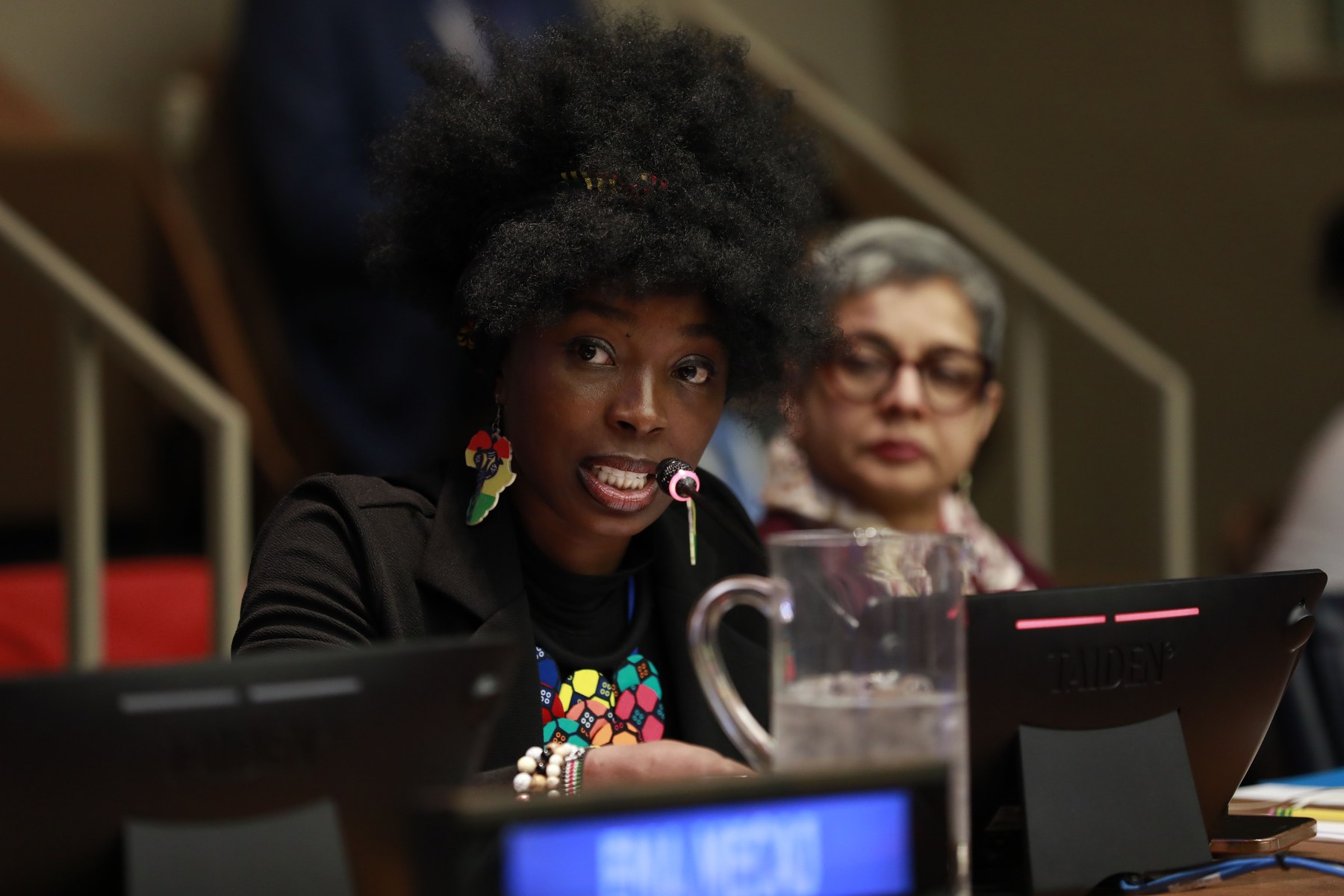
Eva Chisom Chukwunelo speaking into a microphone during a United Nations session

United Nations, New York · March 2025

Portrait

About Eva Chisom Chukwunelo

Eva Chisom Chukwunelo is a Nigerian advocate committed to the rights of persons with disabilities, gender equality, and a fairer representation of African women with disabilities. In March 2025, she brought these issues to New York during the 69th session of the United Nations Commission on the Status of Women (CSW69). There, she notably advocated for disability-disaggregated data, access to sexual and reproductive health, professional inclusion, and the meaningful participation of women and girls with disabilities in the decisions that affect them.

Selected in 2024 for the Mandela Washington Fellowship for Young African Leaders, she completed a program at Florida Gulf Coast University focused on civic leadership, community development, and the design of projects for underserved populations. In Washington, her talk entitled Leave No One Behind extended a central conviction of her advocacy: inclusion cannot remain an abstract ambition when the people concerned are absent from research, public policy, and decision-making spaces.

Her professional path lies at the intersection of writing, education, administration, and prosthetic technology. A graduate of Veritas University in English and Literary Studies, she has worked as a reporter and scriptwriter for the Nigerian Television Authority, an English teacher, a training coordinator, and an administrative assistant at Sun-tech Prosthetics and Orthotics in Abuja. This last experience gave her direct insight into the economic, technical, and human realities surrounding access to prosthetic care in Nigeria.

Also involved with The IREDE Foundation in limb-loss advocacy and as a volunteer counsellor for Project PINK BLUE, Eva Chukwunelo draws on advocacy, storytelling, and personal experience to examine how societies design accessibility, represent disabled bodies, and preserve their memory. Her work defends a simple but demanding idea: inclusion is neither an act of charity nor a communications exercise, but a question of justice, power, and participation.