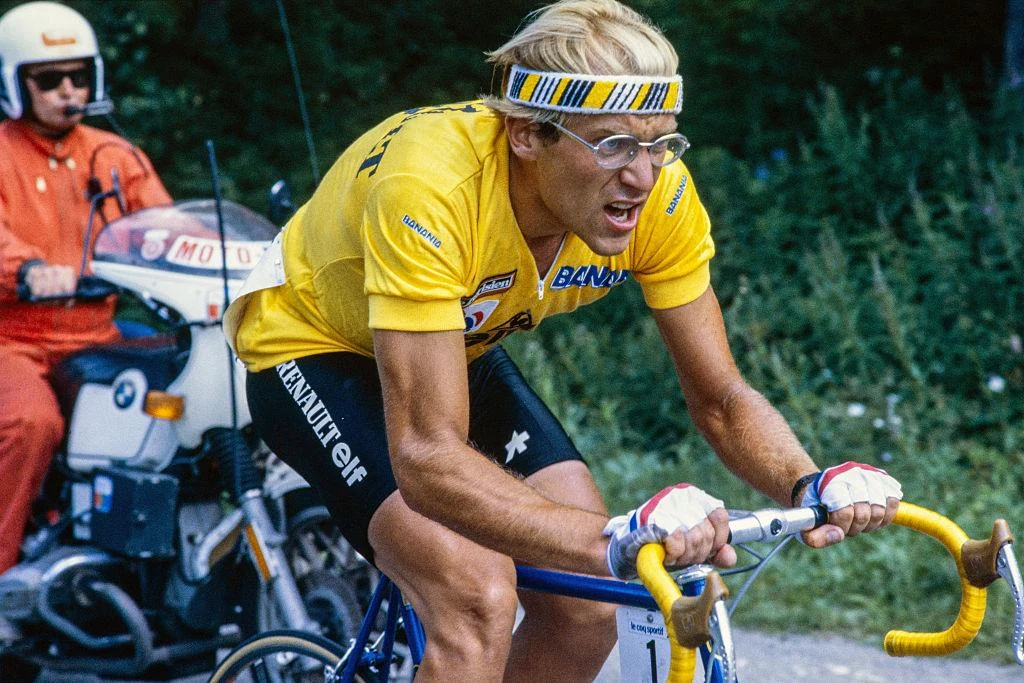
Two Tours de France, a Giro d’Italia, two victories at Milan-San Remo, and a career built on attacking instinct and self-assertion. Yet for many people Laurent Fignon remains the man who lost the 1989 Tour by eight seconds. It is a spectacular image — and a deeply reductive one. From the early television archives of 1982 to his final Tour de France commentary in 2010, Fignon’s life tells a far more complex story: that of a precocious champion who became the rival of his masters, a man forced to deal with defeat, injury, the grey areas of his era and life after racing, but who almost always resisted letting events define him.
1982
Before the legend, a young man who does not yet look like a champion
March 1982. Laurent Fignon is 21, and the contrast is striking. At his family home in Tournan-en-Brie, the young professional shows the television crew his bedroom, his model ships and his books. The large round glasses that will become part of his signature are already there, but the legend is not. Fignon has just joined Renault-Elf-Gitane, Bernard Hinault’s team, and has already won the Critérium International. On screen, however, he looks less like a star than a student who has accidentally discovered a shortcut into elite sport. He even ends the report with a sentence that will echo through the rest of his life: “you shouldn’t believe that cycling takes up an entire life.” The Fignon paradox is already there — a determination not to be reduced to the bicycle, even though cycling will end up structuring almost his entire public existence.
Born in Paris on 12 August 1960 and briefly a university student before committing to racing, Fignon did not fully match the traditional image of the French professional cyclist of his era. His education, his interest in books, his direct language and his glasses quickly generated nicknames built around the “intellectual” or the “professor”. He made little effort to erase the distance. That independence, sometimes read as arrogance, became both a strength and a trap: the public needed time to understand a champion with little interest in conventional modesty.
1983
Winning the Tour before having time to learn it
A year later, the script changes completely. Bernard Hinault, suffering from a knee injury, does not start the 1983 Tour de France. Fignon discovers the race at 22. He is not introduced as the inevitable future ruler of world cycling; first, he is supposed to learn. The race accelerates his destiny. Yellow jersey Pascal Simon crashes, fractures his shoulder blade and continues for several days before abandoning. Fignon takes over the race lead and then strengthens it. In the time trials and the Alps he does not simply defend: he demonstrates that he already possesses the legs and temperament of a winner. In Paris, at his first attempt, he wins the Tour by 4 minutes and 4 seconds over Ángel Arroyo.
The victory is formative precisely because it arrives too early to be comfortable. It turns a prospect into a national reference before he has time to learn gradually how to manage expectations and other people’s projections. The 1983 Tour gives Fignon the summit almost immediately. From then on, any result below victory can be read as regression. His career will not be a linear rise toward glory: it begins with glory and then has to learn how to survive what glory creates.
1984
The moment the pupil becomes the boss
The 1984 season gives the story the dimensions of a sporting novel. In the spring, Fignon rides the Giro d’Italia against Francesco Moser. He wears the pink jersey but loses the race in the final time trial in Verona. The edition remains surrounded by controversy. A mountain stage is cancelled because of snow; later, Fignon will claim that the Italian television helicopter favoured Moser during the final time trial by flying behind him, then hindered Fignon by positioning itself differently. Those allegations became part of the mythology of the 1984 Giro, but they must remain what they are: allegations made by Fignon, not established proof that the race was manipulated.
A few weeks later comes the Tour de France, and this time his answer is total and purely sporting. Bernard Hinault has left Renault for La Vie Claire. The duel between the former leader and his successor contains everything cycling loves: succession, rupture, pride and a hierarchy waiting to be redrawn. Fignon does not merely win his second Tour. He dominates it. He finishes 10 minutes and 32 seconds ahead of Hinault, with Greg LeMond third. At 23, Fignon has already won two Tours and defeated the man who still embodied the supreme reference point of French cycling. At that precise moment, the question is no longer whether he can become the best rider of his generation. It seems to be: how far can he go?
It is also the moment when his public identity hardens. Glasses, uncompromising language and a refusal to bow automatically to authority make Fignon instantly recognisable. He is not a consensual champion. He has convictions, anger, an analytical way of dissecting races and a strong awareness of his own value. He can be admired or judged abrasive; indifference is difficult.

1985-1988
When the body breaks the expected script
After 1984, the story appears to be written: Fignon is supposed to accumulate Tours. That is exactly what does not happen. Injuries, abandonments and uneven seasons interrupt the trajectory. This period is essential because it destroys the illusion that talent guarantees a regular career. The 23-year-old champion discovers what cycling eventually imposes on everyone, including its most gifted riders: the body can refuse the programme that history had prepared for it.
He continues to win. In 1986 he takes La Flèche Wallonne. In 1987 he finishes on the podium of the Vuelta and wins again at the Tour. More importantly, he broadens his range. In 1988 he wins Milan-San Remo and finishes third at Paris-Roubaix. The following year he wins Milan-San Remo again. Back-to-back victories in a Monument underline something that is often erased by the obsession with the Tour: Fignon was not only a general-classification rider. He could read a one-day race, attack, time an effort and improvise. His racing style relied less on cautious management than on movement. He could lose heavily, but he rarely raced simply not to lose.
That personality also explains his complicated relationship with image-making. In his 2009 autobiography, Fignon did not try to sanitise his past: he acknowledged using amphetamines and cortisone within the cycling culture of his era and discussed positive tests. This should neither be erased nor turned into a simplistic moral shortcut. It simply places him fully inside the contradictions and grey areas of 1980s professional cycling.
1989
A magnificent season swallowed by eight seconds
Then comes 1989. In many ways, this should be the season that best defines Laurent Fignon. He wins Milan-San Remo in March. In June, he wins the Giro d’Italia ahead of Flavio Giupponi and Andrew Hampsten. Five years after the frustration of 1984, he finally conquers Italy’s Grand Tour. He therefore reaches the Tour de France with renewed authority and the possibility of completing the Giro-Tour double. Opposite him is Greg LeMond, returning to the highest level after the hunting accident that nearly ended his career. The Tour changes hands repeatedly. LeMond takes yellow, Fignon takes it back, the American responds, and the Frenchman again moves ahead.

On the eve of Paris, Fignon leads by 50 seconds. Only a time trial of a little more than 24 kilometres, from Versailles to the Champs-Élysées, remains. To most observers, the margin appears sufficient. But LeMond uses triathlon-style aerobars that improve his aerodynamic position, while Fignon is dealing with a painful problem around the perineum. On the Parisian avenue, the American produces an extraordinary ride. Then comes the calculation: eight seconds. Eight seconds after three weeks of racing. The smallest gap ever recorded between first and second in the Tour de France.

The image is brutal: Fignon collapses after the finish, his face closed, his body emptied. And the media narrative performs a ruthless transformation. It turns an almost perfect season — Milan-San Remo, the Giro, second in the Tour and other victories — into a story of defeat. Very few champions have experienced such a reversal of meaning. Fignon had already won the Tour twice; from then on, a large part of the public would recognise him first as “the man who lost by eight seconds”. He later inverted the phrase in his autobiography: he was not the man who lost one Tour by eight seconds, but the man who had won two.

That is the heart of his sporting destiny. Sport does not always remember records in their rational order; it remembers scenes. Two victories can become less powerful than one defeat if that defeat has perfect dramatic structure. Fignon becomes one of the clearest examples of this injustice of memory: he will repeatedly be asked to explain those eight seconds as though everything before them had merely been a prologue.
After the champion
Learning to exist without the yellow jersey
Fignon continues racing until 1993. He still wins a Tour de France stage in 1992, proof that he remains capable of major moments long after his peak. But the end of a champion’s career raises a question that no result sheet can answer: what happens when the activity that has organised every day since adolescence disappears? Fignon looks for several answers. He moves into race organisation and, in 1999, buys Paris-Nice. The venture proves financially difficult. It demonstrates that intimate knowledge of cycling does not automatically mean mastery of the cycling business.
His more durable second life comes through broadcasting. As a consultant first with Eurosport and later with France Télévisions, Fignon finds a role that fits him: watching, understanding and explaining. His language remains direct. Again, he does not try to smooth every judgment. Yet what could be interpreted as arrogance when he was a rider gradually becomes a strength behind the microphone: he sees the race from the inside and is willing to say what he thinks. The “professor” eventually discovers in commentary a role that his old nickname had anticipated years before.

2010
The final Tour
In 2009, Fignon announces that he has an advanced cancer of the digestive tract. The diagnosis becomes public at the same time as the publication of his autobiography, Nous étions jeunes et insouciants. It changes the way the public sees him. A man often described as distant is suddenly visibly vulnerable, but his tone does not fundamentally change. He talks about illness with much the same directness with which he talked about the peloton. He does not ask to be turned into a moral hero. He keeps working.
During the 2010 Tour de France, his voice is profoundly altered by illness and by a tumour affecting a vocal cord. Yet he is still in the commentary position. For viewers, the experience is unsettling: they are no longer simply listening to a former champion explain a bike race; they can physically hear the effort required for him to remain present. On 31 August 2010, Laurent Fignon dies at the age of 50. Only a few weeks separate his final Tour commentary from his death.

At that point, the images from 1982 acquire a different meaning. At 21, in his bedroom in Tournan-en-Brie, Fignon had said that one should not believe cycling takes up an entire life. Twenty-eight years later, he was still on the Tour. Not on a bicycle, but in the commentary booth. The sentence was not necessarily wrong. Cycling had not taken all of his life: Fignon repeatedly tried to remain larger than his profession — reading, organising, speaking, arguing, choosing. But the bicycle had become the principal language through which the world knew him, and perhaps the language through which he had learned to read the world.
Beyond the eight seconds
Reducing Laurent Fignon to 1989 means confusing the strongest image with the fairest history. His biography is that of a champion who won too early, dominated while still very young, endured the interruptions of the body, conquered another Grand Tour and then suffered a defeat that became more famous than his victories. It is also the story of an imperfect man, fully part of the contradictions of his cycling era, who did not try to erase them when he eventually told his own story.
The eight seconds created a legend because they give sport what it loves most: an almost microscopic measurement producing an immense consequence. But they say remarkably little about what makes Fignon interesting. What defines him more convincingly is the way he continued after each rupture: after Hinault, after the 1984 Giro, after injury, after the Champs-Élysées, after his professional career. Even when illness changed his voice, he remained part of the conversation.
Some champions are remembered for control. Fignon belongs to a rarer category: those whose story sometimes escapes them, but who keep answering it. Perhaps that is why the figure with the round glasses remains so vivid. Not because he symbolises defeat, but because he reminds us that a sporting life can never be measured only at the point where the stopwatch stops.
Sources and credits
Biographical analysis produced for JLPDécryptage
Sources documentaires principales / Main documentary sources
Source audiovisuelle principale : vidéo fournie pour ce décryptage. Les faits biographiques et résultats sportifs ont été recoupés avec les sources ci-dessous.
• INA — « 1982, dans l’intimité de Laurent Fignon »
• Tour de France — Les double-vainqueurs du Tour
• Tour de France — 1989, le contre-la-montre Versailles–Champs-Élysées
• Giro d’Italia — Archives, édition 1989
• Cyclingnews — Moser vs Fignon, Giro d’Italia 1984
• L’Équipe — Classement général du Tour de France 1984
• Le Monde — Laurent Fignon, coureur cycliste, 1er septembre 2010
• Le Monde — Nous étions jeunes et insouciants, 20 juin 2009
Note éditoriale : les controverses du Giro 1984 sont attribuées à Laurent Fignon et aux sources qui les rapportent ; elles ne sont pas présentées comme des faits établis. Aucun lien causal n’est affirmé entre les pratiques dopantes reconnues par Fignon et son cancer.