
In-depth interview
01
JLPdecryptage
You spent more than twenty-five years at Randstad, notably as an HR Director and later an Operations Director, before creating Organic Office around the concept of managerial intelligence. After working for so long at the heart of HR and operational systems, what did you ultimately come to understand about collective performance that procedures, tools and traditional organisational structures cannot solve on their own?
Patrice Marmouget
What twenty-five years in large organisations taught me is that procedures do not create collective performance; at best, they provide a framework for it. Real performance emerges when the people in a team genuinely understand one another, when a manager knows who they are speaking to, what motivates each person, and how each individual processes information and makes decisions.
I have seen sophisticated HR systems, optimised organisational charts and certified processes... and teams that still failed to perform. And I have seen the opposite: very few tools, a great deal of human insight, and remarkable results.
What tools do not solve is the question of meaning, the alignment of profiles, and the manager-employee relationship. That observation is what led me to create Organic Office: to give managers an objective, actionable reading of their teams, not to label people, but to create the conditions for genuine cooperation.
Collective performance is built on mutual understanding, not on processes.
02
JLPdecryptage
Your career has successively placed you among those who design HR policies, those who run operations, and now those who support managers. In France, 61.7% of 55-64-year-olds were in employment in 2025, compared with 66.4% across the European Union, with a particularly sharp drop after age 60. At what point, in your view, does experience stop being perceived as a skill and start being treated, in some organisations, as a cost, a source of rigidity or a risk?
Patrice Marmouget
The shift rarely happens consciously; it is almost always insidious. In most organisations, it occurs when HR decisions are driven by short-term indicators: payroll costs, mobility, presumed adaptability to digital tools. From that point on, experience is no longer read as value; it is read as a cost or a constraint.
I have been an HR Director. I have taken part in those discussions and I know the mechanics from the inside. What struck me was how quickly collective assumptions replace individual analysis. People stop looking at the person and start looking at age.
Yet a 58-year-old employee who has spent fifteen years in the same company carries contextual, relational and operational knowledge that cannot simply be bought. What Seniors Force Plus measures through the Senior Score is precisely that: making visible what had previously remained invisible.
The problem is not age. It is the lack of tools to value what age and experience produce.
03
JLPdecryptage
Companies readily praise experience in their corporate messaging, yet the labour market can simultaneously penalise profiles perceived as too experienced, too expensive or insufficiently mobile. Is this paradox primarily an economic problem, a cultural bias, or an inability on the part of organisations to measure what experience actually produces?
Patrice Marmouget
All three, but in a specific order: first comes the inability to measure, which feeds cultural bias, which ultimately leads to poorly grounded economic decisions. If an organisation knows precisely what an experienced employee produces in terms of quality, transmission, reliability and fewer operational errors, then the debate about cost changes fundamentally.
The problem is that most companies measure none of this. They measure salary, not value. And when value is not measured, cost always wins the argument. That is exactly why I strongly believe in tools such as ACTIFS+ and the Senior Score: they objectify what had previously been subjective.
The cultural bias is real. In France, we have a particular relationship with youth as a marker of competitiveness. But that bias recedes when data enters the conversation. I have seen executives change their view, not because of a speech, but because a dashboard showed them something they had not been seeing.
That is where the work of Seniors Force Plus truly makes sense.
04
JLPdecryptage
Within Seniors Force Plus, your role is specifically to onboard companies onto ACTIFS+ and support adoption of the platform, which combines the Senior Score with the recommendations provided by G.R.A.C.E. What do you discover when a company agrees to genuinely measure its own practices? Between stated intentions and actual changes in recruitment, career management or day-to-day leadership, where does the strongest resistance lie today?
Patrice Marmouget
What I almost always discover is a gap, sometimes a huge one, between what a company believes it is doing and what measurement reveals. When an organisation agrees to use ACTIFS+, analyse its practices through the Senior Score and move into action with the G.R.A.C.E. guide, something interesting happens: beliefs collide with data.
And data does not lie. The strongest resistance is not where people expect it. It is not an open rejection in principle; today, few companies would openly say that they do not want older workers.
The resistance is operational. Front-line managers, recruiters and HR managers have habits, reflexes and implicit criteria that do not change simply because senior management has signed a charter.
That is where the real resistance lies: in concrete practices. My work with companies is precisely about this - not remaining at the level of intention, but going down into the actions themselves: job postings, shortlisting criteria, annual reviews and skills mapping.
ACTIFS+ makes it possible to measure all of that. That is what makes it useful... and sometimes uncomfortable.
05
JLPdecryptage
Through Organic Office, you argue that a team’s performance depends in particular on a manager’s ability to understand the profiles, motivations and differences within it. That philosophy seems almost naturally intergenerational. When a company fails to make use of the experience of its oldest employees, does that ultimately reveal less of a “senior policy” problem than a management problem?
Patrice Marmouget
Yes, without hesitation.
And that is a conviction I built over twenty-five years in the field. A company that cannot make the most of its experienced employees has a management problem: a problem in reading profiles, valuing differences and creating mixed team dynamics.
What our behavioural-assessment tools consistently show is that profiles are not distributed according to age. An experienced employee can be a driver of innovation; a younger employee can be very conservative in the way they work. Performance comes from complementarity, and complementarity has to be managed. It does not happen by itself.
The “senior” issue is in reality a management issue in disguise. The companies that make the fastest progress are not those with the most ambitious senior policies on paper. They are those whose managers are trained to read their teams, value differences and understand what each profile genuinely brings.
When you manage with that level of clarity, the experience of a 58-year-old employee becomes an asset, not a burden.
06
JLPdecryptage
Successive reforms are leading people in France to work longer, even though employment falls sharply after age 60 and France remains below the European average. Is there not a fundamental contradiction here: extending working lives without yet changing the way companies view the people expected to extend them? Where, in your view, does the real barrier lie today?
Patrice Marmouget
The contradiction is real, and it is serious. We have extended working lives by decree without equipping companies to accommodate them. The result is that we have created a new category of precarious workers: people who are too young to retire and too old for the market.
The main barrier, in our view, is that in France a career is still largely perceived as an upward trajectory, and the experienced worker, by definition, is no longer moving upward. Yet in many European countries, organisations have managed to value expert career paths, transmission, mentoring and progressive retirement as a chosen transition rather than something endured.
In France, progressive retirement exists on paper, but it remains marginal in practice because neither companies nor employees are sufficiently equipped to implement it with confidence. Yet it is a practical lever that would allow companies to retain experience while preparing real knowledge transfer.
Sustainable employability cannot suddenly be decreed at age 55 through an emergency skills assessment. It is built continuously throughout working life, and it is a shared responsibility between the employee, the company and public policy. When we wait until someone is already going off the road before acting, it is often too late.
I have supported dozens of people at the end of their careers who had not undertaken any training in fifteen years, not because they did not want to learn, but because nobody had ever told them that it was also their responsibility. We are harvesting today what we failed to sow.
What deeply frustrates me about the prevailing narrative is that it forgets something essential: experienced workers are champions of change. Not despite their age, but because of it. A 58-year-old employee today has lived through computerisation, the Internet, globalisation, ERP systems, repeated reorganisations, digital transformation, remote work and AI. They have made it through all of it. Sometimes while complaining, perhaps, but they are still here, still functioning, and they have adapted.
That is exactly the kind of profile companies need in a world of constant change: someone who knows that disruption passes, who remembers previous crises, and who does not panic at the first turn. Calling that rigidity is a complete misunderstanding.
The second barrier is the lack of practical tools for companies. Signing a charter or posting a commitment on LinkedIn does not change practices. What changes practices is measuring, making things visible and holding leaders accountable for results - exactly what ACTIFS+ does through the Senior Score.
We will not change mindsets through speeches. We will change them by making the cost of inaction visible.
07
JLPdecryptage
Seniors Force Plus is currently run entirely by volunteers and has built its work around tools, partnerships and growing mobilisation among companies. In your view, what absolutely needs to be preserved from this first phase, and what must evolve if SF+ is to enter a new stage in its development?
Patrice Marmouget
What absolutely needs to be preserved is the insistence on concrete action. SF+ has managed not to remain at the level of intentions: it has produced tools, measurement mechanisms and engaged companies with documented results. That is rare in the non-profit world, and it is what gives the organisation credibility with business leaders.
The Senior Score, ACTIFS+ and G.R.A.C.E. are not slogans; they are operational levers. That culture of measurable results must remain at the heart of SF+’s DNA.
What needs to evolve is the ability to bring in a new generation of volunteers and partners without losing the standards of the first. An organisation that does not renew itself eventually starts living off its initial momentum.
SF+ has built something solid. Now it has to make that work transferable, understandable and attractive to people who were not there at the beginning. That may be the real task of the next phase: ensuring that commitment no longer depends on knowing the founders, but on the strength of the project itself.
08
JLPdecryptage
Your career has taken you from leading teams to supporting managers, then to entrepreneurship and collective engagement within Seniors Force Plus. As SF+ now seeks to consolidate the next stage of its development, what role would you like to play, and what mark would you like to leave on the organisation’s future?
Patrice Marmouget
I want to be useful in concrete terms, not symbolically. What interests me in the next stage is contributing to making SF+ a reference organisation that companies consult not for compliance or image reasons, but because they know it will provide tools, data and methods that genuinely change practices.
What I would like to leave behind is a collective dynamic. SF+ is a volunteer-led venture, and that is precisely what gives it strength and credibility. When a business leader understands that the people speaking to them about the employment of experienced workers are not doing so for a contract or a commission, but because they genuinely believe in the cause, it changes the nature of the conversation.
Volunteering is not a sacrifice; it is a choice rooted in consistency. We cannot argue that companies should commit to their experienced employees if we are not ourselves willing to give time to a cause that goes beyond our immediate self-interest. At SF+, that is why all of us are here, and it is something that must remain at the heart of who we are.
What I would like to see in five years is a network of genuinely committed companies, not merely signatories: companies that talk to one another, share their results and challenge one another. Because the best accelerator for convincing a business leader is a peer who can explain what it actually changed within their teams.
That kind of dynamic cannot be decreed. It has to be built collectively, and that is exactly what SF+ is in the process of doing.
 Organic Office
His background
About Patrice Marmouget
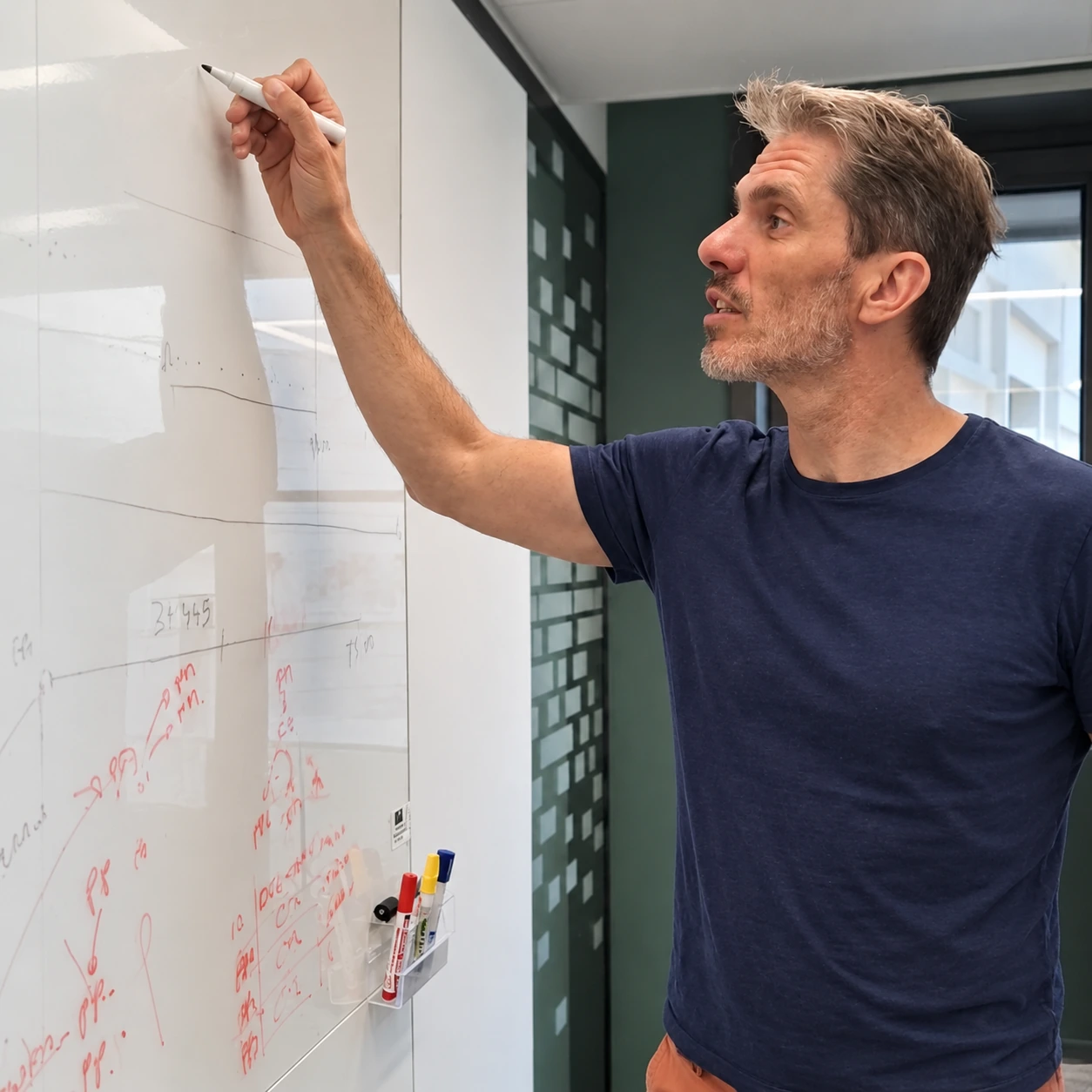
Patrice Marmouget is CEO of Organic Office, a consultancy specialising in managerial intelligence that supports executives, managers and teams in understanding individual profiles, strengthening cooperation and improving collective performance. He spent more than twenty-five years at Randstad, where he held senior responsibilities including HR Director and Operations Director.
He completed the Transformational Leadership Program at London Business School and is certified as a GRI expert by the Growth Resources Institute. He also speaks publicly on management and organisational transformation.
Committed to the employment of experienced professionals, Patrice Marmouget is an executive member of Seniors Force Plus. His role focuses on company onboarding: he helps organisations adopt ACTIFS+, the platform that combines the Senior Score - a self-assessment tool for employment practices - with G.R.A.C.E., a set of recommendations designed to turn diagnosis into practical action.