
NOW · Matter
This Oil Droplet Is Not Alive. Yet It Swallows Its Surroundings
Inert structures made of oil, water, and a polymer manage to change shape and capture their environment, evoking behaviors usually associated with biological cells.
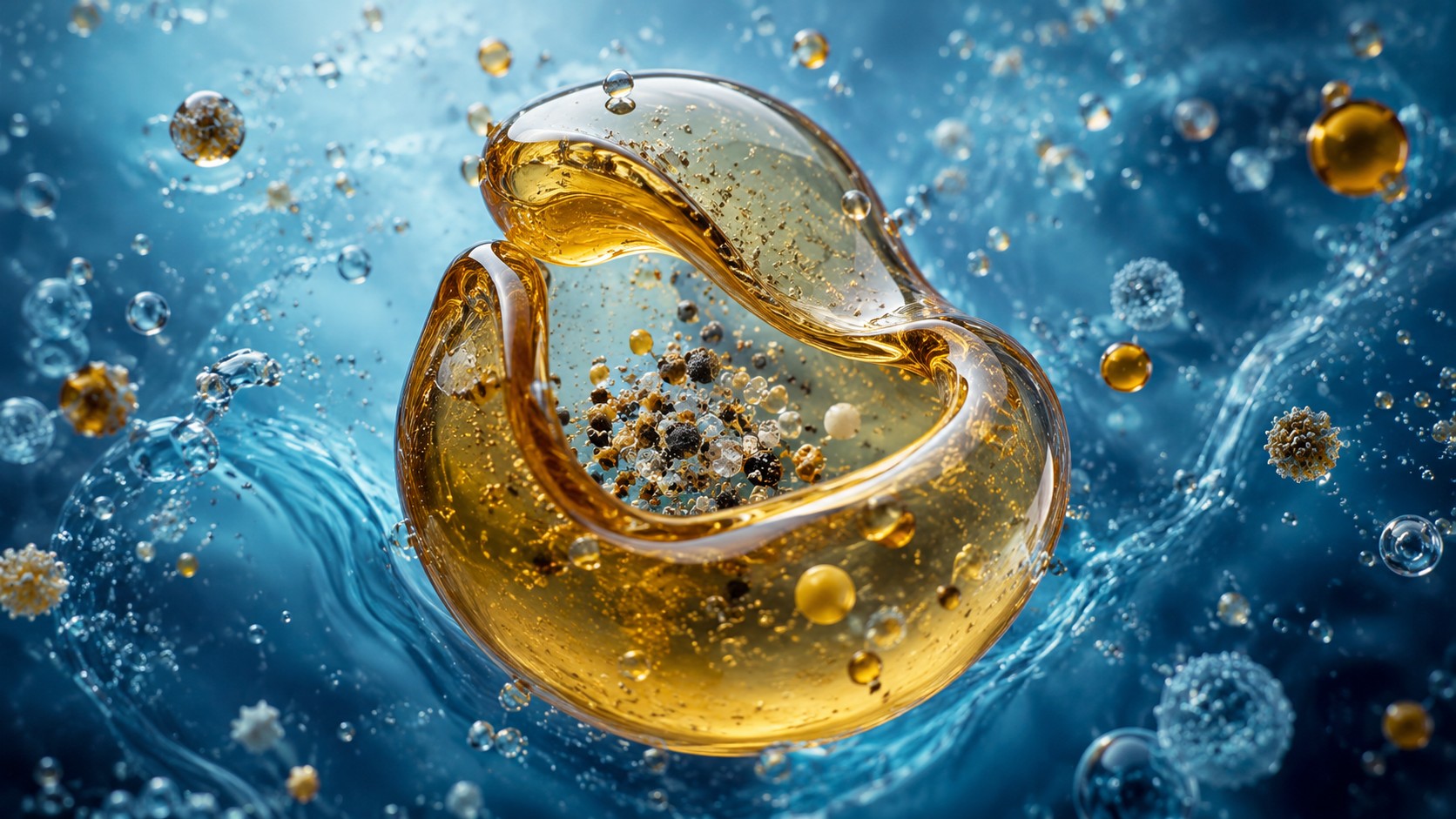
Under a microscope, a tiny sphere of oil floats in an aqueous solution. Suddenly, its smooth surface wrinkles. The droplet flattens, stretches into a disk, then slowly curves to adopt the geometry of an open cup. Soon, its edges fold inward and close around the surrounding liquid, trapping along the way the microscopic particles that were suspended there. The image is striking almost familiar to anyone who has ever watched immune cells in action. Yet no biological machinery orchestrates this movement. There is here no complex lipid membrane, no energy-consuming motor proteins, no metabolism, no genetic code dictating this choreography.
This fascinating experiment, published in July 2026 in Nature Communications, was carried out by a team at New York University (NYU). The researchers including postdoctoral fellow Florent Fessler, chemist Stefano Sacanna, and physicist Paul Chaikin — set out to understand how inert matter can mimic some of the most characteristic behaviors of living things. To achieve this, they used ingredients of disarming simplicity: microscopic oil droplets, water, and a surfactant polymer. This molecule, soap-like in nature and known as the block copolymer P123, has the particular property of positioning itself at the interface between oil and water, thereby altering the surface tensions that govern the droplet’s shape.
By adding this polymer to initially spherical droplets, the researchers observed a spontaneous metamorphosis. The oil then adopts a variety of shapes reminiscent of flowers, tree-like branches echoing dendritic cells, dumbbells, or disks. Even more remarkably, this process can be controlled and reversed experimentally. By adjusting the polymer concentration or slightly changing the sample’s temperature through simple heating and cooling cycles, the team can guide the droplets from one shape to another, and then reverse certain morphological transformations.
The most striking observation concerns this capacity for ingestion. When thermodynamic conditions allow, the droplet folds in on itself, engulfing the surrounding fluid and trapping its contents inside. Florent Fessler emphasizes that this absorption behavior closely resembles, in its overall form, macropinocytosis. This biological process, sometimes nicknamed "cell drinking," describes the way a living cell gulps large mouthfuls of its extracellular environment, either to feed on it or to probe it. The fundamental difference lies in the total absence of biological components: the oil droplet achieves this autonomously, through physicochemical laws alone, whereas a cell must expend considerable energy to deform its cytoskeleton.
This technical feat invites us to reconsider the thin line separating inert matter from living matter. In an organism, macropinocytosis requires a precise assembly of proteins and metabolic expenditure. As Stefano Sacanna points out, it is surprising to realize that such cellular machinery is ultimately not indispensable for producing behaviors that appear identical. The emergence of these complex forms shows that generic physical rules are sufficient to generate structures and movements we instinctively associate with biology.
By analogy, this system can also fuel broader reflection on how complex behaviors might arise in matter devoid of genome or metabolism. It does not, however, constitute a complete model of the earliest cells, nor a demonstration about the origin of life. More modestly, it shows that compartmentalization, shape transformation, and matter capture do not always require biological machinery. Physics can produce certain elementary manifestations of these phenomena within a carefully controlled artificial system.
Far from creating life in a test tube, this work primarily opens pathways for the engineering of tomorrow’s materials. Paul Chaikin notes that isolating such shape changes is particularly difficult to study within living organisms, which are drowned in constant biochemical noise. This synthetic system offers a purified platform for dissecting the underlying principles. In time, these morphogenic droplets could inspire the design of adaptive materials capable of restructuring themselves in response to environmental stimuli. Stefano Sacanna envisions the creation of tiny protective capsules able to engulf and preserve precious cargo, paving the way toward new, highly versatile capture vehicles.
Ultimately, this oil droplet makes no claim to becoming a living organism. Rather, it elegantly reminds us that life’s most sophisticated behaviors are deeply rooted in physics. Even before the emergence of DNA or proteins, the laws of matter already allowed for self-organization, shape changes, and interactions with an environment. Biology may simply have exploited and refined a physical repertoire that existed before it.